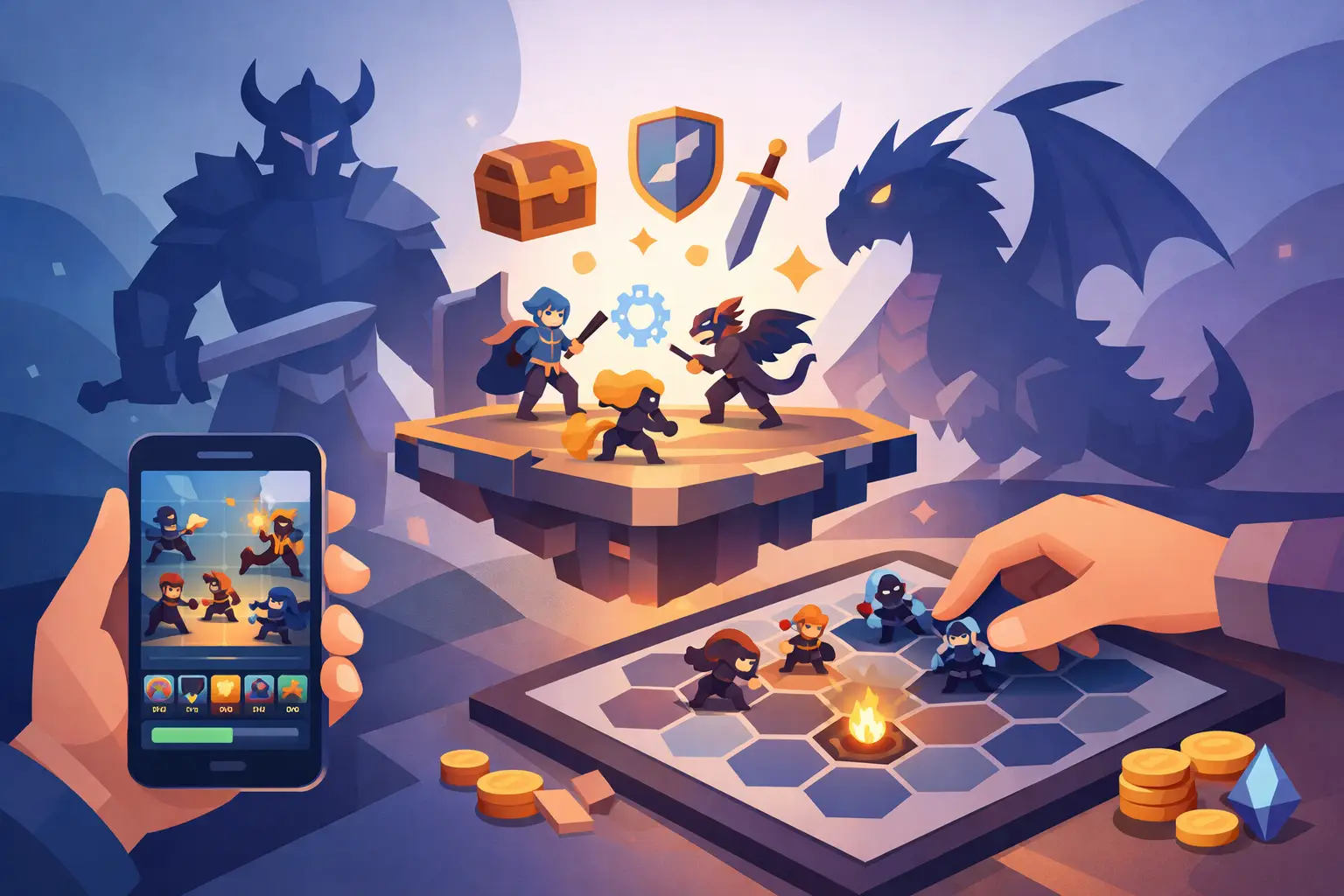
A battle that plays itself can still expose every weakness in a Warlord’s plan. In an auto battler, the final clash is automatic, but the outcome is earned long before the first skill is cast. The formation, the Familiars chosen, the equipment assigned, and the sacrifices made during progression all arrive at the same moment: the fight.
That is the appeal. An auto battler does not ask who can tap fastest. It asks who can read a threat, build for it, and live with the consequences when the Gates open.
An Auto Battler Is Strategy Before the Fight
Automated combat is often misunderstood as passive combat. The animations may unfold without direct commands, but preparation becomes the real battlefield. Every stat, skill level, position, buff, debuff, and team bond has a purpose. A victory can look effortless only because the player made difficult decisions before the battle began.
This creates a different kind of tension from an action RPG. There is no last-second dodge to save a broken formation. If a frontline collapses too quickly, if a healer is exposed, or if damage is aimed at the wrong enemy, the battle reveals the flaw without mercy. The player then returns to the roster, studies what failed, and rebuilds.
For mobile RPG players, that loop has real value. Battles can continue while attention is divided, yet meaningful progress still requires thought. A short session can include upgrading a Familiar, shifting a formation, testing a counter, and claiming the result. The game respects time without removing strategy.
Formation Is More Than a Row of Characters
Positioning is one of the clearest ways an auto battler separates a prepared team from a random collection of powerful units. A durable defender placed at the front can shield fragile damage dealers. A support Familiar kept out of immediate danger may have enough time to restore health, cleanse a curse, or strengthen the team before the enemy breaks through.
But safe positions are not always the right positions. Some attackers need to stand closer to trigger their strongest effects. Some enemies punish clustered teams with area attacks. Others bypass the frontline entirely and hunt the weakest target. A formation that dominates one encounter may be torn apart in the next.
The strongest answer depends on the enemy’s behavior. Before changing everything, look for the actual point of failure. Did the tank fall first? Did the enemy backline cast unchecked? Did a control effect prevent a crucial skill? Specific questions create useful adjustments. Replacing an entire squad after every loss usually does not.
Roles Matter, but Synergy Matters More
A balanced team usually needs protection, damage, and sustain or control. That foundation matters, especially early in progression. Yet a team built only from labels can become predictable and weak. A high-damage Familiar with no protection may never reach its second cast. A defensive unit that offers no pressure can leave the team trapped in a war of attrition.
Synergy is where a roster becomes a strategy. One Familiar may weaken an enemy’s defenses while another strikes hardest against vulnerable targets. A protector may grant a shield at the exact moment a fragile ally enters danger. Debuffs can turn a long fight into a controlled execution, while buffs can give an otherwise modest unit a decisive role.
This is why collection should never be only about rarity. A new Familiar is a possible answer to a problem that has not appeared yet. The right unit at the right time can be more valuable than a stronger unit that does not fit the formation.
Progression Gives Every Win a History
The best auto battler systems make power feel built, not simply handed over. Levels matter, but they should not be the only measure of strength. Evolution, equipment, stat empowerment, skill growth, and deeper bonds create reasons to keep investing in a roster over time.
That investment should involve choices. A resource spent evolving one Familiar may delay another. Equipment can be moved to solve an immediate obstacle, but doing so may weaken a team needed elsewhere. A player who spreads resources across too many units gains flexibility, while a player who commits deeply to a core formation may gain a sharper edge. Neither approach is always correct.
The question is what the current challenge demands. Campaign progression may reward consistency and survival. Raid battles may favor specialized damage and carefully timed effects. Competitive matches can force players to anticipate common formations and hide their true threat behind a defensive shell.
Blood Legends builds this pressure around Warlords and their Contracts with Familiars. The Warlord is not a disposable character to replace after a lucky summon. The choice carries forward, shaping how a player approaches a world damaged by corruption, war, and ancient Gates.
Why Skills Should Change Decisions
Skills are most satisfying when they do more than increase a damage number. A stun can stop an enemy’s decisive ability. A barrier can buy one more turn for a healer. A bleed or curse can make a defensive enemy vulnerable over time. A passive that changes targeting can completely alter the value of a formation.
When evaluating a skill, consider its battlefield job. Does it protect the team, eliminate a priority target, extend survivability, or create an opening for another Familiar? Then consider reliability. A powerful effect that triggers too late may be less useful than a smaller effect that consistently shapes the first moments of combat.
This is also where experimentation becomes rewarding. Test one meaningful change at a time. Move a Familiar, alter a piece of equipment, or adjust a skill path, then watch the result. Small tests reveal more than broad, unfocused rebuilding.
Losses Are Information, Not Wasted Energy
A difficult encounter should leave evidence. Perhaps the enemy uses heavy area damage. Perhaps its frontline cannot be broken before the backline takes control. Perhaps the battle is close, but a single Familiar dies before using a crucial skill. Each failure points toward a different answer.
Players who improve fastest do not just ask how to raise team power. They ask why the team lost. Raw power can overcome some barriers, but it cannot replace a formation built for the encounter. A squad that survives longer, controls the right enemy, or creates better skill timing may defeat an opponent with a higher displayed rating.
That does not mean every loss is a puzzle that can be solved without progression. Sometimes the honest answer is that the team needs stronger equipment, higher levels, or another evolved Familiar. The key is recognizing when strategy has reached its limit and when the roster needs time to grow.
Competitive Play Makes Preparation Visible
Against scripted enemies, patterns can eventually be learned. Against other players, certainty disappears. A real-time multiplayer opponent may bring a defensive formation designed to outlast burst damage, a fast team built to erase fragile units, or an unusual combination that punishes familiar answers.
This is where roster depth matters. Building one perfect team is satisfying, but building several credible options is safer. A reserve Familiar with cleanse, control, anti-defense pressure, or survival tools may appear ordinary until a specific opponent makes that tool essential.
Competitive play also rewards restraint. Chasing every new unit or rebuilding after every defeat can drain resources and obscure what already works. A disciplined Warlord understands the core team, identifies its bad matchups, and develops targeted answers rather than abandoning the entire strategy.
The Real Reward Is Watching the Plan Hold
An auto battler earns its place when combat feels like the verdict on a plan. The player should be able to watch a formation endure a first assault, see a debuff create an opening, and recognize why a hard-fought victory happened. Automation removes button pressure, not ownership.
Build a team with a purpose. Let every Familiar have a role, let every loss reveal something useful, and let the next battle prove whether your Warlord has learned from the last one.