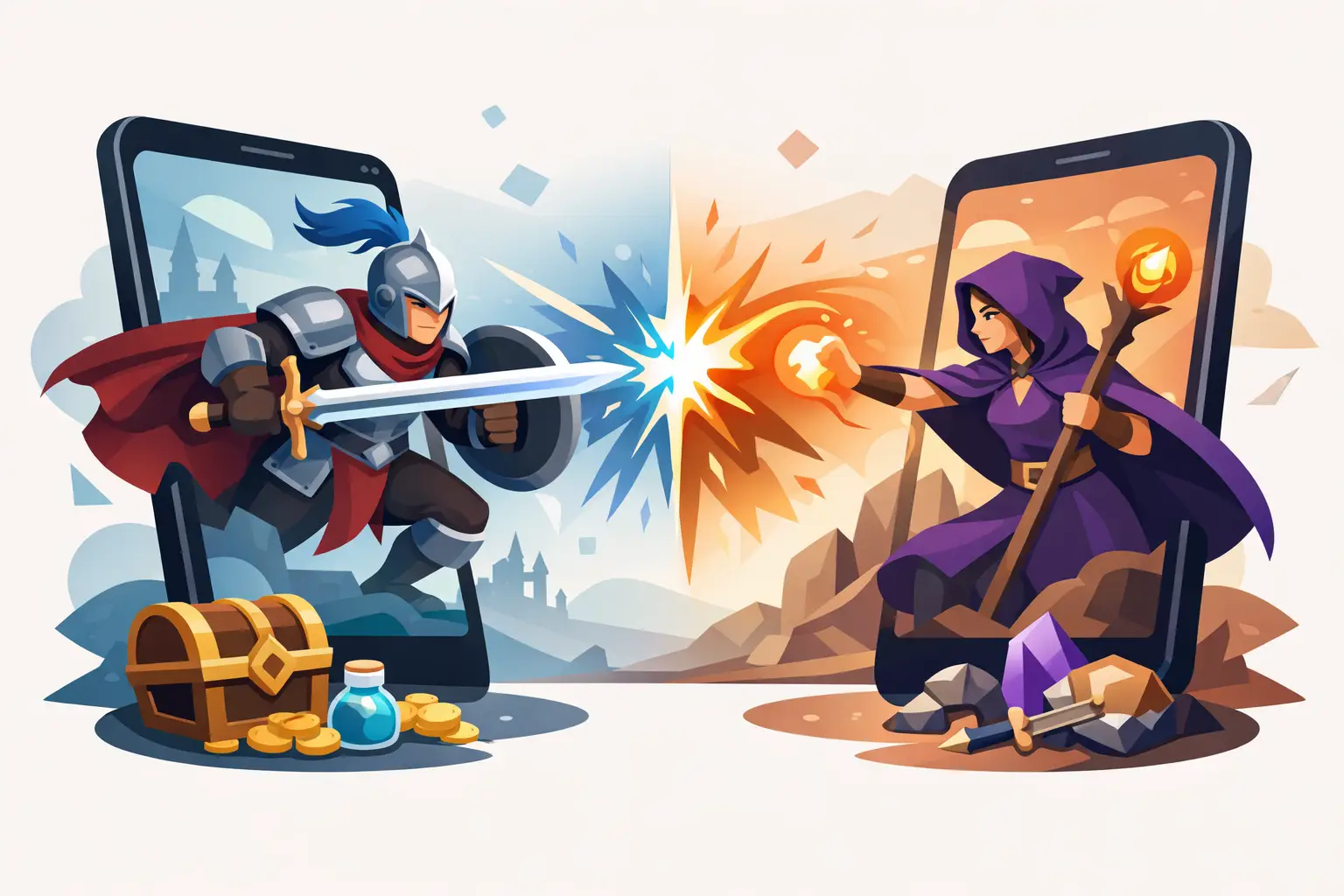
A real time PvP RPG reveals the truth behind a player’s roster quickly. The Familiar that dominates a story battle may fall apart against an enemy formation built to silence its skills. A Warlord who looks weaker on paper may control the field long enough for a patient opponent’s damage dealers to finish the work. In the shadow of the Gates, raw power is only one weapon.
For players who enjoy dark fantasy collection games, real-time competition adds a different kind of pressure. You are not simply clearing a stage designed to be beaten. You are facing another Warlord’s choices: which Familiars they raised, which skills they awakened, where they placed their strongest units, and what risks they were willing to take. Every battle becomes a test of preparation.
A Real Time PvP RPG Is More Than Fast Combat
The phrase can mean different things across mobile RPGs. In some games, players manually activate every skill during a live match. In others, combat resolves automatically, but the match itself takes place live against another player’s current team. Both approaches can create tense competition. What matters is whether the outcome is shaped by meaningful decisions rather than by a single number beside a character’s name.
Blood Legends takes the strategic route. Combat is fully automated, but it is not thoughtless. Your Warlord, Familiars, formation, equipment, buffs, debuffs, skills, and team composition determine what happens when the battle begins. The fight moves without waiting for constant taps, leaving the real question where it belongs: did you prepare for the enemy standing across from you?
That distinction suits mobile play. A match can be immediate and intense without demanding that players execute perfect reflex inputs on a small screen. The strategic work happens before the first strike. Then the formation must live or die by the Contract you built.
The Formation Is Your First Decision
Positioning is often the difference between a promising roster and a dangerous one. A durable Familiar placed at the front can buy precious time. A fragile damage dealer hidden behind allies may have enough space to unleash its strongest skills. A support unit positioned poorly can be removed before its buffs ever matter.
There is no universal formation that defeats every opponent. A front line built to absorb direct damage may be vulnerable to effects that punish clustered targets. A team designed to strike quickly can falter against healing, control, or defensive buffs. A slow, resilient lineup may survive the opening assault only to lose if it cannot close the battle.
This is where PvP becomes more compelling than a simple power race. You are reading the shape of an enemy team. Are they protecting one devastating Familiar? Are they relying on attrition? Do they have a back line that must be reached early? A formation should answer those questions, not merely display your highest-level units.
Positioning Creates Trade-Offs
Putting your strongest defender in front is usually sensible, but it may expose another weakness. If your support Familiar needs protection, moving it farther back may improve survival while changing how quickly its abilities influence the fight. If a certain unit performs best against the enemy’s front line, placing it where it can engage sooner may be worth the danger.
Good PvP decisions rarely feel completely safe. They are calculated sacrifices made before combat begins.
Collection Has Purpose When Every Familiar Has a Role
Hero collection is at its best when a new character is not just a larger stat total. In a real time PvP RPG, Familiars should create options. One may bring control that interrupts an enemy’s momentum. Another may weaken defenses. Another may protect allies or punish teams that depend on a single damage source.
That makes the hunt for new Familiars more than a search for rarity. Capturing enemies, summoning new allies, and expanding the collection can change how you approach competitive battles. A Familiar that seems situational today may become essential when the current opponents favor a formation it counters.
Long-term progression matters here as well. Leveling, evolving, empowering stats, equipping gear, and developing skills through Blood Bond let players invest in the Familiars they believe in. Yet investment should be deliberate. Spreading resources across every new recruit can leave a roster without a reliable core. Focusing only on a few familiar choices can make a team predictable and vulnerable.
The strongest path is usually a balance: build a dependable foundation, then keep enough depth to adapt. A Warlord with several answers is harder to corner than one who has perfected only a single plan.
Why Automated Battles Still Demand Skill
Automated combat sometimes gets mistaken for passive combat. That ignores the layers of decision-making that happen before the battle starts. If a loss exposes an enemy weakness you failed to target, the answer is not always to add more power. It may be a change in formation, a different Familiar, a better equipment choice, or a revised skill setup.
This creates a useful rhythm for mobile players. You can enter a live battle without needing to perform a long sequence of manual inputs, then study the outcome and refine your team. The tension comes from commitment. Once combat begins, your preparation is on trial.
There is also an honest limitation to this style. You cannot rescue a flawed setup with a last-second button press. Players who want constant manual control may prefer a different type of PvP game. But for collectors and strategists, automated battles can make roster knowledge and formation planning matter more consistently.
Growth Changes the Battlefield
Competitive modes are healthiest when progression creates more choices instead of closing the door behind veteran players. A player with a deeper collection will have advantages, especially in a game built around long-term growth. That is part of the reward for time spent building Contracts and surviving the world’s dangers.
Still, progression alone should not settle every encounter. Team synergy, targeted counters, and intelligent positioning give players a way to challenge stronger-looking opponents. A fully developed Familiar that is poorly matched to the enemy plan can become less valuable than a lower-powered unit chosen for the right effect.
This is also why evolving content matters. Events, raid battles, new Familiars, and shifts in the competitive environment keep old assumptions from hardening forever. A static meta eventually turns collection into routine. An evolving world asks players to reconsider what they own and what they need next.
Learn From Every Defeat
The best losses are specific. Perhaps your front line collapsed before your back line could act. Perhaps an enemy debuff shut down the core of your strategy. Perhaps your team survived but lacked the damage to finish the fight. Each result points toward a decision you can change.
Avoid rebuilding everything after one defeat. Look for a pattern across several matches. If the same weakness appears repeatedly, then it is time to adjust your formation, strengthen a key Familiar, or add a counter to the roster. Patience is a competitive resource.
The Social Stakes of the Arena
PvP is not only about rewards or rankings. It is the place where the community’s creativity becomes visible. Two players can own similar Familiars and still build entirely different teams. One may favor durable control and gradual pressure. Another may gamble on a brutal opening attack. Both can succeed when their choices fit the opponent.
That variety gives a dark fantasy arena its pulse. Beyond the story locations and corrupted lands, there are other Warlords preparing their own Contracts, guarding their own secrets, and waiting to test them against yours. The enemy is not a fixed stage. The enemy is learning too.
Bring a formation you understand, not merely one that looks powerful. Study what breaks when it loses, preserve what works when it wins, and let every battle reveal the next shape your roster must take.