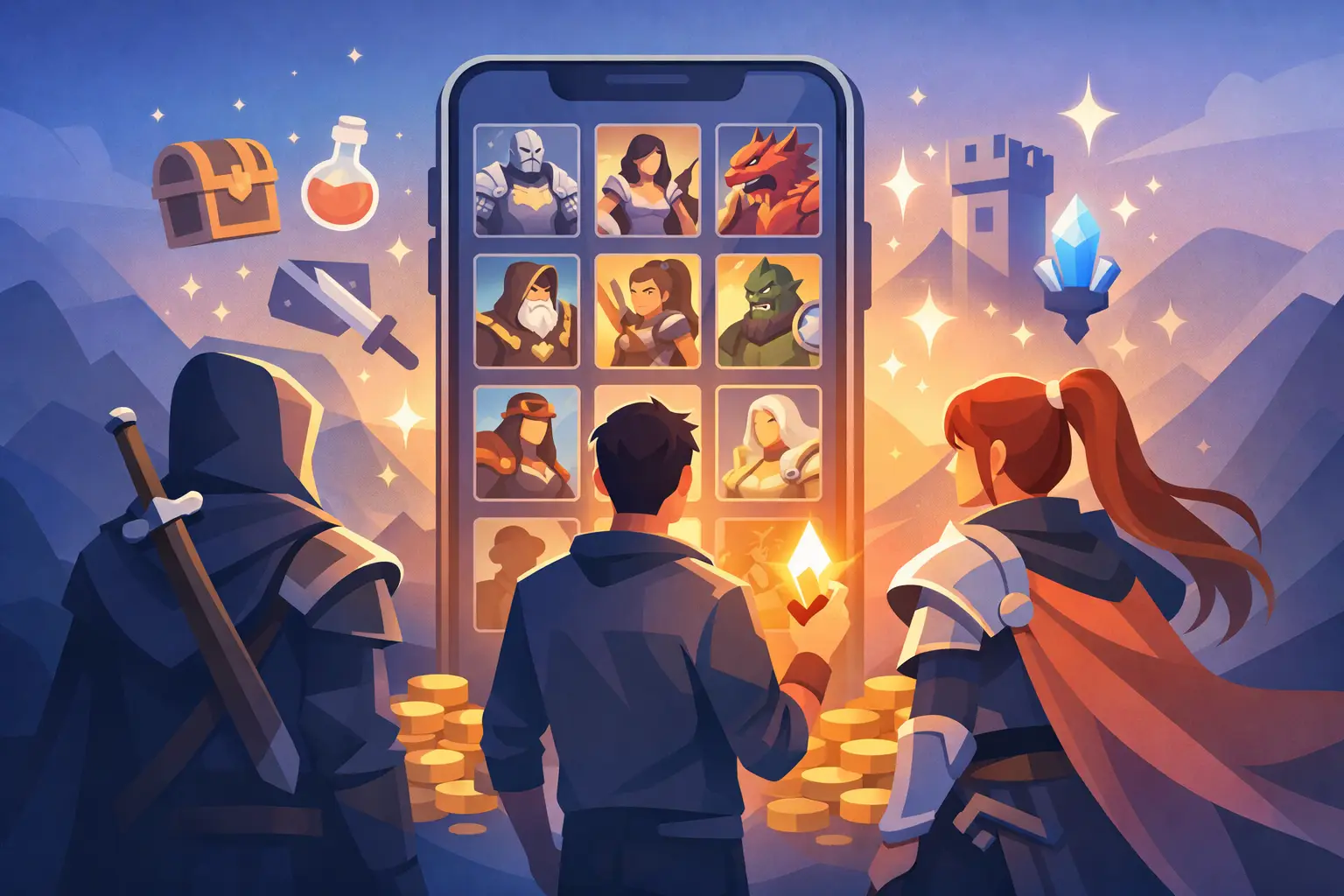
A hero collector RPG earns its place on a phone when every new character feels like more than a number added to a roster. The strongest games make a recruit feel dangerous, strange, useful, or full of untold history. They give players reasons to study a character’s skills, protect their weaknesses, and decide where they belong when the next battle begins.
Collection is the promise. Strategy is what gives that promise weight.
A Hero Collector RPG Needs More Than Rare Characters
The thrill of a summon never disappears entirely. A new high-rarity Familiar can change the direction of a team, open a difficult encounter, or become the foundation for a future formation. But rarity alone cannot carry a game for long. If every powerful character solves every fight in the same way, the collection becomes decoration.
A worthwhile roster creates tension between raw power and practical value. A durable defender may keep fragile damage dealers alive. A support Familiar may look modest in isolation yet become essential when paired with the right debuffs or buffs. A lower-rarity unit may fill a precise role that a legendary character cannot. The question should not always be, "Is this character stronger?" It should often be, "What does this character change?"
That difference matters because collecting is a long-term relationship. Players invest resources, time, and attention into the characters they choose to raise. Each Familiar should offer a path forward through levels, evolution, equipment, stat growth, and skill development. Progress should feel earned, but it should not be so punishing that one early mistake ruins a player’s account.
The best systems leave room to experiment. A player who captures an unexpected enemy or summons an unfamiliar Familiar should see possibility rather than clutter. Not every recruit needs to become a permanent part of the main formation. Some exist for a niche encounter, a raid mechanic, a future mode, or simply because their story and design make them worth keeping.
Formation Strategy Turns Collection Into Command
In a hero collector RPG, the battle screen may be automated, but the outcome should never feel automatic. This is where formation strategy becomes the heart of the experience.
Before combat begins, a Warlord makes decisions that matter: who stands in the front line, who is shielded in the rear, which skills complement one another, and whether the team can survive the enemy’s opening assault. Positioning gives combat a visible logic. A fragile caster placed carelessly should be vulnerable. A defender placed where attacks converge should have the tools to endure.
Team composition also gives the roster purpose. Damage is necessary, but damage without control, protection, healing, or disruption can collapse against a prepared enemy. A formation built for fast victories may fail in a drawn-out boss battle. A defensive group that survives arena pressure may lack the force needed to defeat a raid target before its deadliest phase.
There should be no single formation that rules every fight forever. Meta strategies will emerge, especially in competitive modes, and that is part of the appeal. Yet a living game must keep creating pressure against complacency. New enemies, altered raid conditions, limited events, and changing battle rules can ask players to look again at the Familiars gathering dust in their collection.
That does not mean every update must invalidate old investments. Constant replacement creates fatigue, not excitement. The better approach is to create new decisions. Let established teams remain valuable while new combinations, counters, and objectives create fresh reasons to adapt.
Automated Combat Still Demands Judgment
Automated combat works best when it respects preparation. It removes repetitive input during routine battles, allowing players to focus on the choices made before the first strike. Stats, skills, formation placement, equipment, buffs, debuffs, and Warlord selection become the language of tactical control.
The trade-off is clarity. If a formation loses, players need enough information to understand why. Was the front line broken too quickly? Did a key debuff land at the wrong time? Did the enemy resist control effects? Were the team’s damage types poorly matched to the encounter? A battle result that feels unreadable teaches nothing.
Clear combat feedback gives defeat a purpose. It turns failure from a wall into a message: change the formation, improve a Familiar, alter equipment, or return with a different plan.
Dark Fantasy Gives Every Recruit a Shadow
A collection game becomes more memorable when its characters belong to a world with scars. In dark fantasy, those scars can be ancient Gates, spreading corruption, broken kingdoms, political betrayal, exile, and the quiet cost of survival. The setting should not exist only behind menu art. It should shape the characters players collect and the places they fight through.
A Familiar feels more real when its power has consequences. Perhaps it was born near a Gate, bound by a failed ritual, hunted by those who fear its bloodline, or changed by a war no one remembers honestly. Those details do not need to arrive in long blocks of exposition. A line of dialogue, a ruined location, a cinematic glimpse, or an evolving character bond can reveal more than a history lesson.
This is why Warlords matter. They are not interchangeable avatars passing through the story. Choosing one of several permanent Warlords creates identity. The player is not merely collecting weapons with faces. They are forming Contracts, making alliances, and gathering forces in a world that may not survive its own past.
Blood Legends RPG builds this tension around Warlords, Familiars, corruption, and Gates that threaten civilizations already close to collapse. The goal is not darkness for its own sake. It is to make victory feel costly, alliances uncertain, and every powerful recruit like someone carrying a secret into battle.
Progression Must Respect Time and Choice
Mobile players return because they want to see movement. A Familiar gains levels. An evolution changes its presence. Equipment sharpens a role. Blood Bond reveals a skill that reshapes a formation. These steps create momentum across short sessions and long campaigns alike.
Still, progression has a difficult balance to hold. If every system demands the same scarce resources, choice becomes stressful rather than strategic. If progress is too generous, the roster reaches its final form before players have learned what it can do. The right pace gives players meaningful near-term goals while preserving distant ambitions.
A good progression path also supports recovery. Players will build a character that later proves less useful than expected. They will miss an event, lose a competitive streak, or return after time away. Some friction is natural in a long-running RPG, but permanent regret drives people away. Flexible resource systems, alternative paths to materials, and events that reward participation can keep the world demanding without making it hostile.
Competition and Community Keep the World Moving
Real-time multiplayer adds a different kind of pressure. An arena opponent is not simply a scripted enemy with larger numbers. Their formation reflects another player’s priorities, discoveries, and risks. Winning feels sharper because the opponent may have seen the same Familiars and built something entirely different.
Raid battles and events broaden that shared experience. A raid boss can demand coordinated thinking from an entire community, especially when its mechanics reward more than a single damage race. Events can spotlight underused characters, reveal pieces of lore, and give returning players a clear way back into the conflict.
Trading must be handled carefully in a collection RPG. The Bazaar can make eligible Familiars feel connected to a larger player economy, but trading should not erase the value of earning a character through play. Limits, eligibility rules, and thoughtful safeguards protect both collectors and the health of the game.
The most enduring communities do not form around perfect balance patches or endless rewards alone. They form around shared stories: the impossible raid clear, the strange formation that worked, the Familiar someone refused to abandon until it became their signature weapon. A dark fantasy world grows stronger when its players have stories worth carrying into the next battle.
Choose a roster that asks for more than your luck. Find the Familiars that fit your Warlord, test the formation no one else expects, and let every victory leave a mark on the world still standing.