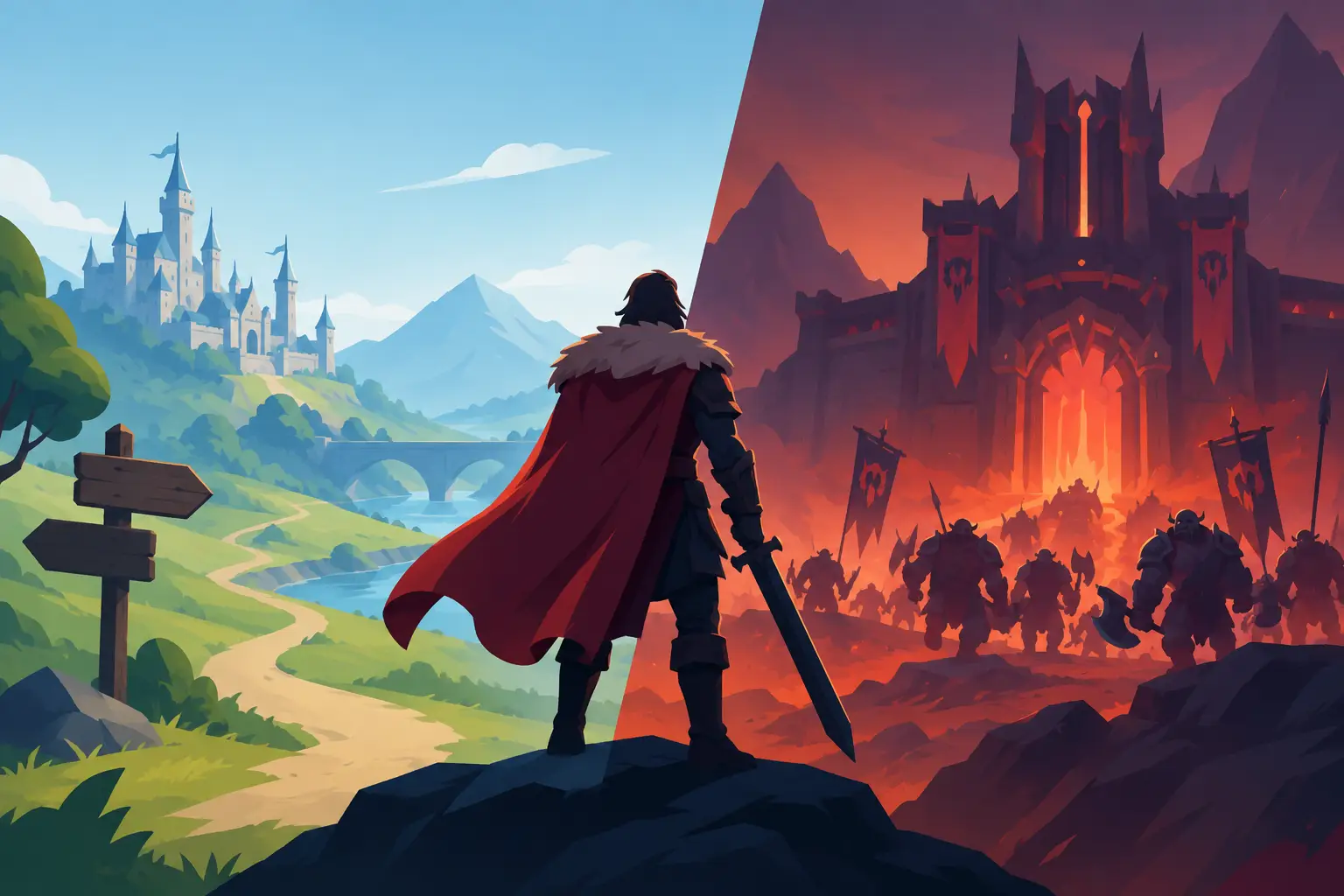
A Warlord may leave one battle carrying a fragment of a dying kingdom's history. From the next, they may leave with a shattered formation and a hard lesson about a boss that refuses to fall. Story quests versus raid battles are not simply two paths to rewards. They ask different things of your Familiars, your preparation, and your patience.
In a dark fantasy RPG, both battles belong to the same war. One reveals why the world is collapsing. The other proves whether your Contract-bound forces can survive what has emerged from the ruin. Knowing when to pursue each mode turns scattered progress into a stronger campaign.
Story Quests Versus Raid Battles Serve Different Oaths
Story quests are the road inward. They carry a Warlord through corrupted settlements, broken strongholds, ancient thresholds, and the scars left by the Gates. Their value is not limited to experience, equipment, or the next stage cleared. They establish the enemies, factions, and losses that make each victory feel connected to a larger catastrophe.
Raid battles are the wall that does not move. A raid boss is designed to test the long game: evolved Familiars, deliberate formations, skill interactions, equipment choices, and a team that can remain effective over a punishing fight. Where story content often asks, “Can your party advance?” a raid asks, “Can your party endure, adapt, and contribute enough damage before the enemy devours the field?”
Neither is automatically the better use of energy or time. The right choice depends on where a Warlord has reached a breaking point. If the campaign is locked behind stronger enemies and missing resources, story progression may be the priority. If a team clears normal encounters but crumbles under prolonged pressure, raids expose the weakness that story stages can hide.
What Story Quests Teach Your Formation
Story quests are often the clearest place to learn how a roster actually behaves. Automated combat does not remove strategy. It makes every choice made before the battle more meaningful. Positioning a fragile damage dealer away from early pressure, placing a durable Familiar where it can absorb the first assault, or choosing support effects that keep the formation stable can decide a stage before the first skill is cast.
Because story encounters change in pace and enemy composition, they are useful for testing a wider collection. A newly summoned Familiar may look promising on paper, yet struggle when enemies apply debuffs or reach the back line. Another may seem modest until a specific formation gives its skills room to work. Story quests provide repeated, understandable situations where those truths become visible.
They also reward breadth. A campaign built around corruption, political fracture, and ancient Gates should not feel like a corridor of identical fights. One location may favor sustained defense, while another punishes teams that lack burst damage or cleansing. Players who develop more than one answer gain flexibility when the world shifts beneath them.
That does not mean every Familiar must be leveled equally. Spreading resources too thin can leave an entire roster underpowered. Build a dependable core first, then use story stages to identify the second line of Familiars worth evolving, empowering, or strengthening through Blood Bond. The goal is not to collect strength at random. It is to learn which Contracts deserve deeper investment.
Story Progression Creates Context for Power
A raid boss can be mechanically demanding, but story quests give that power a reason to exist. The best campaign battles make a Warlord feel the cost of each advance: a city already abandoned, an ally compromised by corruption, a Gate whose presence poisons everything around it.
This matters because long-term progression is easier to sustain when it has a destination. Grinding for equipment becomes less hollow when that equipment is preparing a formation for the next dangerous region. For players who value character collection and worldbuilding in equal measure, story quests are not a detour from serious progression. They are the spine of it.
Raid Battles Reveal the Weaknesses Story Can Forgive
Raid battles are where comfortable habits are punished. A formation that wins quickly against ordinary enemies may rely on short bursts, lucky timing, or a single Familiar carrying every encounter. Against a massive foe with punishing attacks and deep health reserves, those habits become liabilities.
The central question in a raid is usually not whether your highest-rated Familiar is powerful. It is whether the entire team works toward the same purpose. Damage matters, but so do survival tools, debuffs, buffs, healing, protection, and the order in which enemies pressure your formation. A boss that targets the front can make durability essential. A boss that weakens the whole party may demand cleanse effects or greater resistance. A fight with strict damage pressure can reward teams built around coordinated offense rather than isolated stars.
Raids also make investment decisions sharper. It is tempting to pour every resource into a favorite Familiar, especially one with dramatic damage numbers. Yet raid progression often improves faster when the formation's weakest role is repaired. A stronger protector can keep damage dealers alive long enough to matter. Better equipment on a support Familiar can turn a collapse into a stable cycle. An evolved specialist may outperform a more famous character because its skills answer the boss's mechanics.
In Blood Legends, that preparation carries into a living competitive and cooperative world. A raid is not only an enemy to defeat. It is a measure of how carefully a Warlord has assembled a force from captured, summoned, and cultivated Familiars.
Raids Reward Patience, Not Blind Repetition
Failure in a raid should produce information. Watch which Familiar falls first, when damage drops, whether key debuffs remain active, and whether your frontline is buying enough time. If the answer is unclear, change one meaningful variable rather than rebuilding the entire team after every attempt.
This is where many players lose resources. They respond to a difficult boss by upgrading everything at once, then cannot tell which improvement mattered. A better approach is slower: adjust the formation, test it, strengthen the role that failed, and return. The boss may still win for a while, but each attempt becomes part of a plan rather than a ritual of frustration.
Choosing Where to Spend Your Next Session
When time is limited, use the obstacle in front of you as the guide. If campaign progression has stalled, return to story quests. The next location may offer the resources, account experience, or roster testing ground needed to break through. If your story formation is stable but your growth has become shallow, raid battles may reveal the upgrades that will matter most.
There is also a question of mood. Some sessions call for exploration: advancing the narrative, meeting new threats, and seeing what waits beyond the next ruined gate. Others call for discipline: refining a formation, chasing a better result, and facing an enemy that has already beaten you twice. A strong mobile RPG should make room for both without pretending they satisfy the same desire.
Players focused on collection can benefit from alternating modes. Story content helps reveal where new Familiars fit into the world and the roster. Raids clarify which of those Familiars have enduring strategic value. Competitive players should not neglect the campaign either, since the resources and system knowledge gained there often feed stronger multiplayer formations later.
Let the World Set the Test
Do not treat story quests as easy content to rush or raid battles as a damage check to brute-force. One teaches your formation to survive a changing world; the other tests whether it can stand against a single overwhelming threat. Every cleared chapter and every raid attempt should leave you with a clearer sense of who belongs at the center of your army.
When the Gates stir again, take the team you have truly learned to command. That is the force most likely to endure.