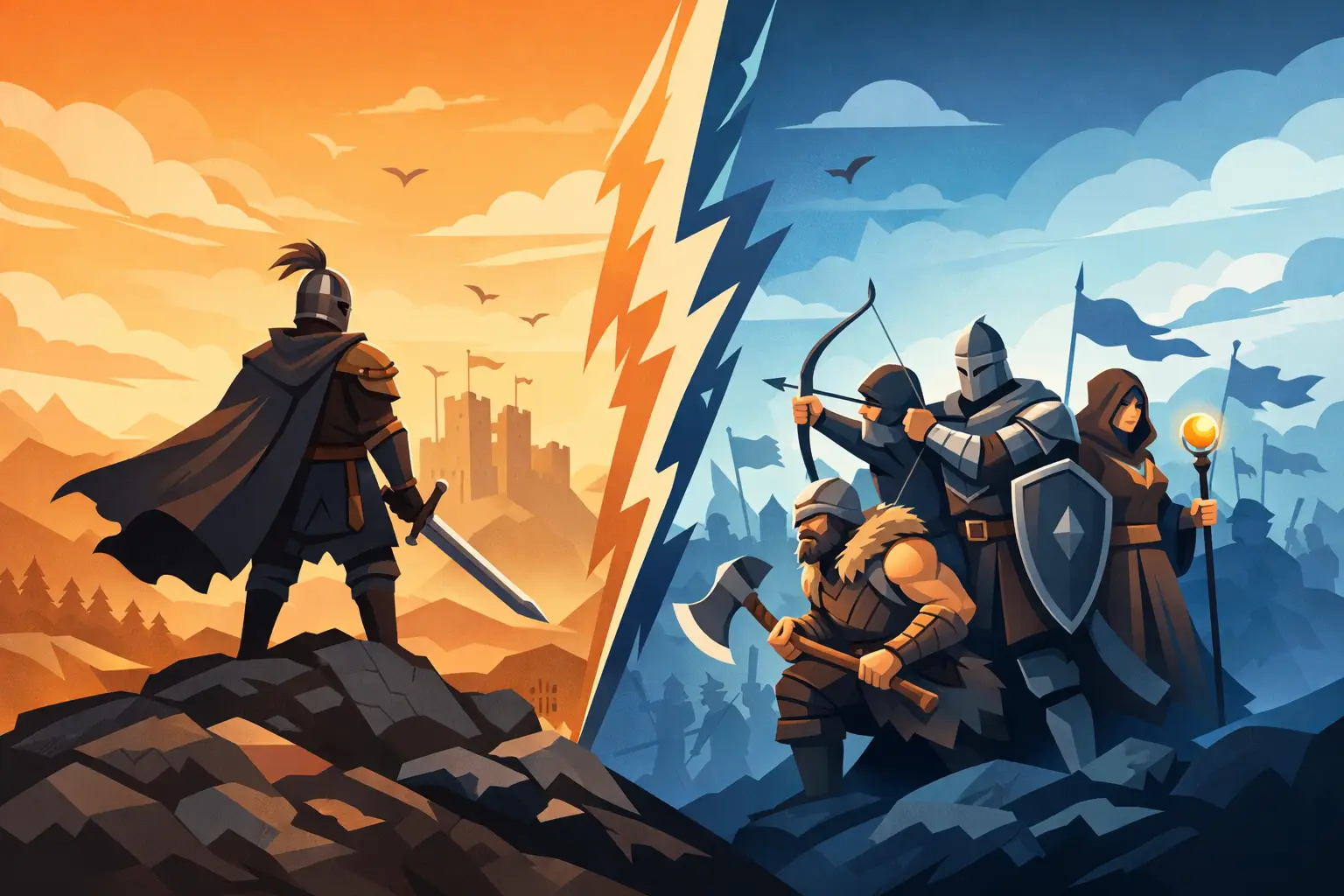
A sealed Gate does not care whether a Warlord stands alone or enters the field beside others. It only measures what remains when the corruption clears. Solo versus team modes ask different things of the same collection: one tests the strength of your preparation, while the other tests how well your strategy survives contact with other players.
For a hero-collector RPG, neither path is merely a different queue. Each rewards a different kind of attention. Solo play exposes every weakness in a formation. Team-focused and multiplayer battles add uncertainty, adaptation, and the pressure of another Warlord’s choices. Knowing when to pursue each mode can make progression feel deliberate rather than draining.
What Solo Versus Team Modes Really Test
The simplest distinction is not difficulty. It is responsibility.
In solo modes, every result begins with your roster. Your Warlord, Familiar selection, formation positions, equipment, Blood Bond choices, and upgrades must carry the fight without help from another player. Automated combat does not remove strategy here. It makes the preparation phase more important. Once the battle begins, your decisions have already been written into the formation.
This is where dependable teams are forged. A durable frontline has to hold long enough for damage dealers to work. Healing, shields, debuffs, crowd control, and damage timing must support one another instead of competing for the same moment. A single powerful Familiar can win an early encounter, but long solo campaigns punish teams that rely on one answer to every threat.
Team modes, including competitive multiplayer and group-oriented encounters when available, test something less predictable. You still need a strong formation, but strength alone is not enough. You need to recognize opposing patterns, anticipate burst damage, and understand whether your team can endure a fast battle or outlast a defensive one. When multiple players affect the outcome, coordination and awareness become as valuable as raw power.
That difference matters because a roster built only for solo reliability may struggle against players who exploit its habits. Conversely, a formation tuned entirely to punish common multiplayer defenses can be too fragile for a long story stage or raid encounter.
The Case for Walking the Dark Road Alone
Solo content is where progress becomes permanent. Story-driven locations, campaign battles, resource stages, and many challenges give you controlled conditions to learn what your Familiars actually do. There is room to test a new evolution, compare equipment, or move a support unit from the rear line to the center and see whether the entire formation changes.
That control has real value on mobile. A solo battle can fit into a short session, but its rewards can strengthen every future mode. If a fight fails, the cause is usually visible: your front line collapsed, an enemy backline remained untouched, a key skill arrived too late, or your power was spread across too many underdeveloped Familiars.
Solo play is also the right place to invest in foundation before chasing spectacle. New Warlords often make the same costly mistake: they upgrade every interesting Familiar rather than building one coherent core. A focused team with clear roles usually progresses further than a scattered collection of rare but unfinished units.
Build for consistency, not one perfect victory
When preparing for solo encounters, ask whether your formation can win repeatedly. A strategy that depends on a narrow opening, one lucky critical strike, or a single fragile damage dealer may clear once and fail five times afterward. Consistency matters when energy, attempts, or time are limited.
Use difficult stages as information rather than a wall. If the enemy defeats your frontline before your damage reaches them, more damage may not be the answer. You may need better positioning, a defensive Familiar, stronger equipment, or a different target priority. Automated combat rewards players who treat defeat as a battle report.
Solo modes are particularly valuable when you are expanding a roster. Captured or newly summoned Familiars do not reveal their place in your strategy from their appearance alone. Test them in lower-risk content first. A unit that seems modest on its own may become essential beside a Warlord or Familiar that amplifies its strengths.
When Team Modes Change the Rules
Multiplayer brings another Warlord into the equation. In real-time competition, the opponent is not a static encounter designed to be solved once. They are adapting, improving, and looking for the same cracks in your formation that you are looking for in theirs.
This makes team modes a proving ground for roster depth. A single established formation may dominate until it meets an opponent with stronger control effects, an unexpected defensive layer, or a composition built to erase vulnerable backline units. The solution is not to rebuild your entire account after every loss. It is to develop alternatives.
Keep more than one answer available. A sturdier lineup can be useful against sudden burst. A faster, more aggressive formation may be necessary against slow defensive teams. A control-heavy option can disrupt enemies that depend on one devastating skill cycle. The exact counter will depend on your collection, but the principle remains: flexibility is a weapon.
Team modes also create a different emotional rhythm. Solo defeat can feel clinical because the enemy follows a pattern. Losing to another player can sting, especially when the margin is thin. Do not let that turn into reckless spending or random upgrades. Review the battle with the same discipline used in campaign content. Identify the decisive exchange and change one variable at a time.
Competition is not the only reason to join in
The strongest reason to engage with multiplayer is perspective. Other players reveal combinations you may have overlooked, defensive setups that force you to reconsider your formation, and priorities that become clearer only under pressure. A living RPG community does not make every Warlord stronger in the same way, but it can make every Warlord sharper.
Events and raid battles often push this further. Long fights against powerful enemies may reward sustained damage, survivability, debuff management, and careful roster planning more than quick arena victories. A Familiar built for a short competitive clash may not be your best answer against a boss that survives several skill rotations.
For this reason, avoid treating team modes as a separate game that begins only after solo progression ends. Your campaign roster feeds your competitive options. Your multiplayer experience reveals which investments have lasting value. Raids test whether your collection can endure when brute force fails.
How to Divide Your Time Without Falling Behind
There is no universal ratio between solo and team play. It depends on where your account is weakest and what you enjoy. Still, a practical rhythm helps.
Early on, prioritize solo progression enough to establish a reliable main formation and gather the materials needed for leveling, evolution, equipment, and skill growth. The goal is not to rush every system at once. It is to create a team that can farm the resources required to improve.
Once that core is stable, spend regular time in multiplayer or team-oriented modes. Do not wait until your roster feels perfect. It never will. Early losses are useful because they expose which roles you are missing and whether your formation has an obvious weakness.
As your collection grows, separate your investments by purpose. Your main team should remain strong enough to carry dependable solo progress. Then develop secondary Familiars that solve specific problems: better sustain, stronger control, focused damage, or a counter to a recurring enemy pattern. This takes patience, but it protects you from the trap of endlessly tearing down your only viable formation.
Resource limits should shape the decision as well. If an event offers rare progression materials, it may deserve attention even if you prefer the story. If a difficult solo stage blocks access to a major upgrade path, return to it with a revised formation. Choose the battle that moves your account forward, not simply the battle that feels easiest.
Let Your Formation Tell the Story
Blood Legends is a world of collapsing powers, ancient Gates, and Warlords who survive by binding danger to their will. Your roster should feel the same way. A successful formation is not a pile of high numbers. It is a contract between Familiars with distinct roles, each one covering a weakness another cannot endure alone.
The best path is rarely pure solitude or constant competition. Build alone when you need certainty. Enter team modes when you need pressure, perspective, and a reason to evolve beyond familiar habits. Then take what you learned back to the next battle, where the Gate is still waiting.