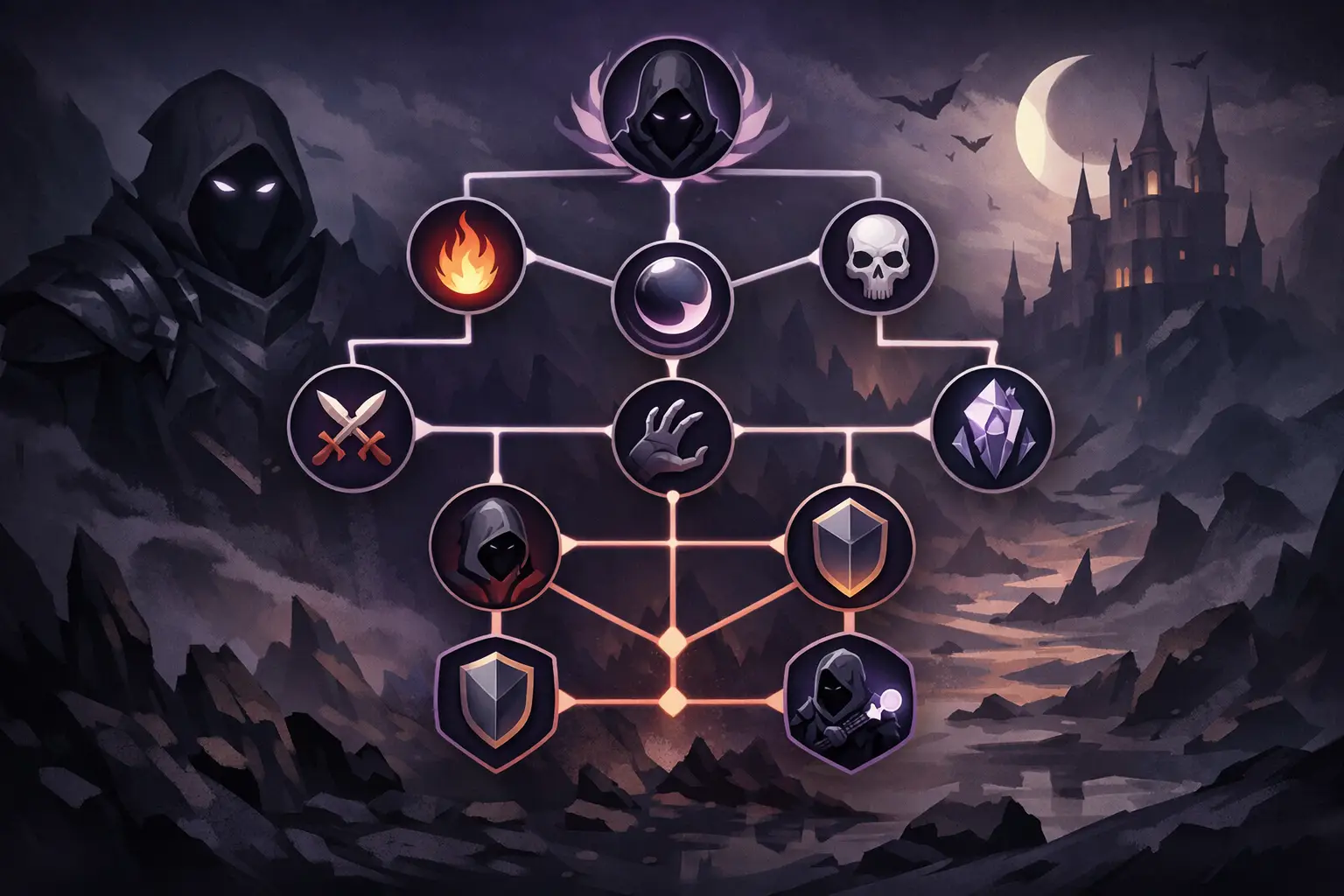
A skill tree can make a newly recruited Familiar feel dangerous, or turn a promising fighter into a costly mistake. In a hero-collector RPG, the question is rarely which node has the largest number. This RPG skill tree guide is about choosing power that serves your formation before corruption, rival Warlords, and raid enemies expose every weakness in your plan.
Automated combat does not remove strategy. It moves strategy to the decisions made before the battle begins: who stands at the front, which effects trigger first, where scarce materials go, and whether your team can survive long enough for its strongest skills to matter.
Start With the Battle Role, Not the Brightest Node
Every skill decision should begin with a role. A Familiar built to absorb damage needs different growth than one meant to weaken enemies, protect allies, or finish a wounded target. A node can look powerful in isolation and still be the wrong choice if it fights against the unit's job.
Frontline defenders usually value durability, damage reduction, self-healing, guard effects, and control resistance. Their purpose is to hold the line while the rest of the formation works. A fragile damage dealer, by contrast, often benefits more from attack scaling, critical effects, speed, or skills that reach priority targets. Support Familiars may gain more from healing strength, buff duration, energy recovery, cleansing, or survival tools that keep them active.
The enemy determines whether that role needs to shift. A campaign encounter with heavy area damage may demand sturdier backline units. A raid boss that cannot be easily controlled may make control-focused branches less valuable than sustained damage or defense reduction. In real-time multiplayer, speed and opening effects can decide a battle before a slow, expensive skill reaches full value.
Before spending materials, ask one blunt question: what must this Familiar do for the formation to win? If the answer is unclear, wait. A saved resource is not wasted. A misplaced one can haunt your roster for weeks.
Read the Whole RPG Skill Tree Guide Before Committing
The first visible branch is not always the real decision. Skill trees often contain prerequisites, tier gates, and late nodes that change the value of everything leading to them. Spend a minute tracing each route to its endpoint before investing.
Look for three things. First, identify the final effect: does it improve damage, survival, consistency, or team utility? Second, count the nodes required to reach it. A powerful capstone may be too expensive for a Familiar you only use in one mode. Third, check whether the path contains useful gains along the way. A route with several relevant bonuses is safer than one that forces you through dead stats for a single prize.
This matters most when a Familiar has more than one viable identity. A unit with decent damage and debuff potential might become a reliable boss specialist or a disruptive arena piece. Trying to make it excellent at both can leave it merely adequate. Specialization creates sharper formations, while balanced paths are better when a Familiar must cover many early-game needs.
Do not assume a higher-tier node is automatically better. A modest speed increase that lets your debuffer act before the enemy can be worth more than a larger damage increase that arrives too late. Timing is a stat, even when the tree does not name it that way.
Treat Skill Points as a Limited Blood Pact
Skill materials are not just currency. They are future options. Early progression creates pressure to spend quickly because each upgrade produces a visible gain, but your roster will expand through summons, captures, events, and story rewards. The Familiar that carries your first formation may not be the one you rely on later.
Invest deeply when a unit has a clear place in your core formation, scales well with evolution or Blood Bond progress, and remains useful across more than one activity. Be cautious with temporary replacements, narrow counters, and Familiars whose kits overlap heavily with a stronger character you already own.
A practical approach is to build one dependable team first rather than scattering points across every new recruit. Give your frontline enough strength to survive, establish one or two meaningful damage sources, then support the pieces that make those roles consistent. This avoids a roster full of partially developed units that cannot carry a difficult battle.
Build Around Synergy, Not Individual Power
The strongest skill tree choice is often the one that makes another Familiar stronger. A damage bonus is useful. A damage bonus that activates after an ally applies bleed, fear, a mark, or defense reduction can be decisive. The same is true of shields, healing, taunts, and turn-order effects.
Study your formation as a chain of events. Perhaps a fast support Familiar begins with a debuff, a ranged attacker follows with increased damage against weakened enemies, and a defender keeps both alive through the enemy's first assault. In that formation, the support's speed or effect accuracy may deserve investment before the attacker's next damage node. Without the opening debuff, the damage branch loses part of its value.
Positioning also changes tree priorities. A frontline Familiar can justify defensive skills because it receives the earliest pressure. A backline caster may need only enough protection to survive stray attacks, allowing more points to go toward output or utility. If enemy skills frequently strike the rear line, that calculation changes. The battlefield is not a fixed equation.
In Blood Legends RPG, Warlords, Familiars, equipment, formation placement, buffs, and debuffs all contribute to the final result. A tree should strengthen that larger machine rather than compete with it. If your gear already supplies abundant critical chance, a branch that provides more of it may have diminishing value. If your Warlord grants shields, skills that improve shield duration or capitalize on protected allies may become far more attractive.
Choose Different Paths for Campaigns, Raids, and PvP
There is no universal best build because the world asks different things of a formation. Campaign battles reward steady progression, survivability, and tools that answer varied enemy groups. A broadly useful path is often the right choice while you are still pushing through story locations and learning what the corrupted lands will send against you.
Raid battles are usually tests of endurance and repeated value. Single-target damage, defense shredding, healing efficiency, damage-over-time effects, and reliable rotation speed can matter more than burst skills designed to erase weaker enemies. A raid specialist does not need to shine everywhere. It needs to help the team endure a long fight against something that refuses to fall.
Multiplayer is more volatile. The first turns, crowd control, counterplay, and target access can outweigh raw totals. A slower but devastating skill may never trigger if your opponent removes its user early. Here, defensive opening tools, speed, resistance, and effects that disrupt an enemy's formation can be worth their cost.
If respec options are available, use them with intent rather than chasing every loss. Change a build after you identify a repeated problem: your frontline collapses, your debuffs fail, your damage arrives too slowly, or your raid team runs out of endurance. One battle can be bad luck. A pattern is a reason to rebuild.
Test One Change at a Time
Skill trees tempt players into changing several things at once. New gear, a new formation position, additional levels, and a different branch can all make a battle look better or worse. The trouble is that you learn nothing about why.
When possible, test a single choice in a repeatable fight. Watch who falls first, whether key effects land, how long your main damage dealer survives, and whether the formation stalls at a particular point. Damage totals help, but they are not the whole story. A lower-damage support may be the reason your strongest attacker gets two extra turns.
Keep notes in simple terms: “frontline dies before healer acts” or “boss resists defense break too often.” Those observations point toward decisions more clearly than vague impressions. They also protect you from chasing a dramatic tooltip when the real weakness is placement or equipment.
A skill tree is not a monument. It is a living part of a formation shaped by new Familiars, deeper Bonds, harsher Gates, and enemies that learn to punish old habits. Build with purpose, spend with patience, and let each battle reveal where the next drop of power belongs.