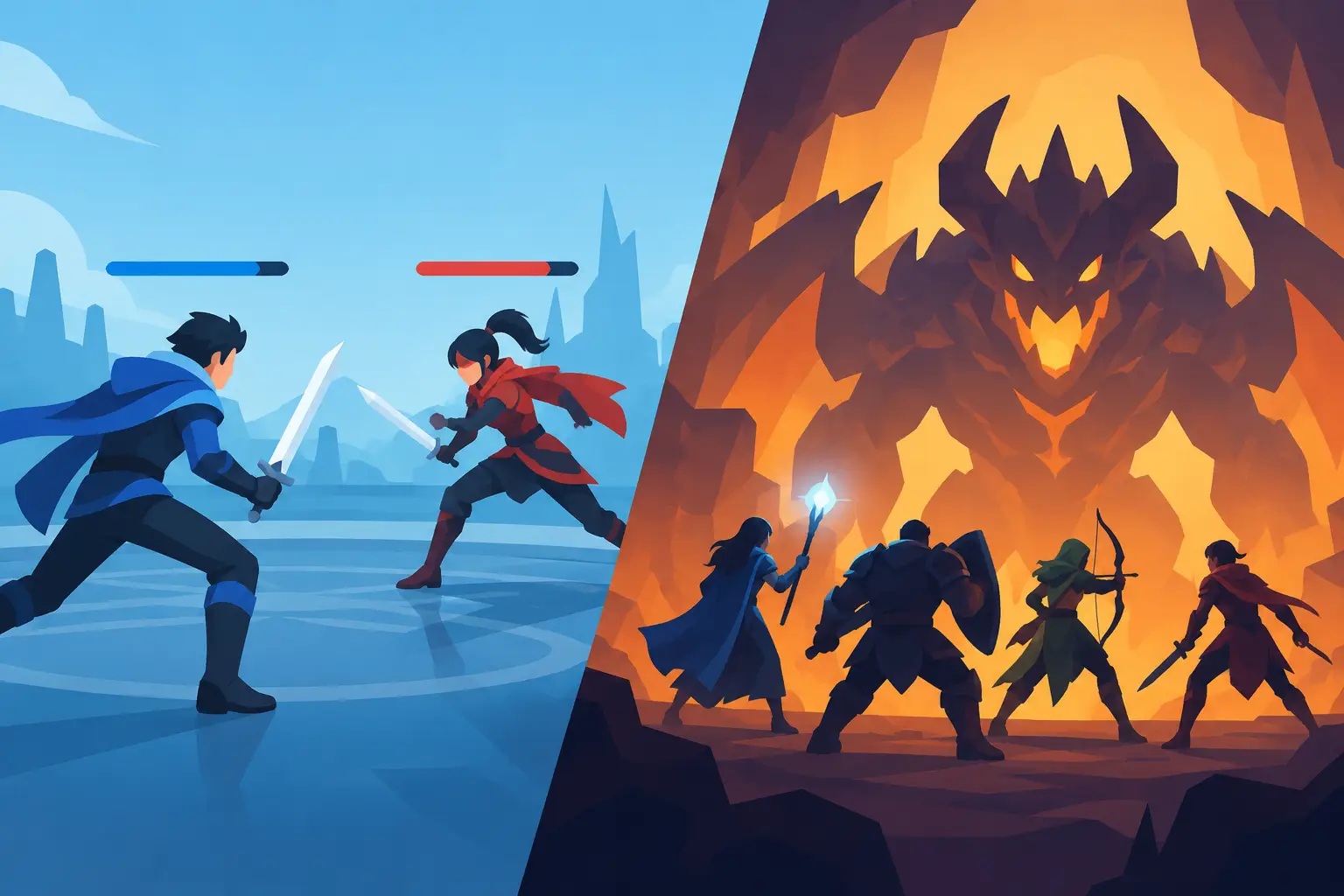
A Gate opens, and the threat on the other side does not care how rare your Familiar is. In real-time PvP versus raids, the same collection can lead to two very different wars. One battle is fought against another Warlord who can react, adapt, and expose a weak formation in seconds. The other is a long struggle against a monstrous enemy built to endure.
Neither mode is simply harder than the other. They test different forms of strength. PvP asks whether your formation can survive uncertainty. Raids ask whether your roster can withstand repetition, pressure, and a foe with enough health to turn small mistakes into disaster.
For Warlords building their power in Blood Legends RPG, understanding that divide matters. A team that crushes an arena opponent may collapse before a raid boss. A carefully prepared raid formation may be too slow or too predictable when a rival player reads its weaknesses.
Real-Time PvP Versus Raids: Two Different Wars
Real-time PvP is a contest of pressure. Even in an RPG where combat resolves automatically through stats, skills, positioning, buffs, debuffs, and team composition, the battle begins long before attacks land. You choose which Familiars to field, where they stand, what role they serve, and which threats your formation is prepared to answer.
Then there is the human element. An opponent may bring an aggressive formation designed to erase fragile backline damage dealers. They may lean into control effects, defensive endurance, burst damage, or a counter to a strategy that has become common among competitive players. You are not only fighting their characters. You are fighting their judgment.
Raids place a different enemy before you. A raid boss is not trying to outthink you in the moment. It is built around a dangerous pattern, punishing mechanics, escalating damage, and immense endurance. The encounter demands preparation more than prediction. You need a formation capable of maintaining damage while surviving the boss long enough for that damage to matter.
That difference changes how each victory feels. PvP can be sudden, tense, and personal. Raids are battles of attrition, where every upgrade and well-timed adjustment becomes visible over a longer fight.
PvP Rewards Adaptation Under Pressure
A strong PvP formation does not need to defeat every possible opponent. It needs a clear plan, enough flexibility to execute it, and the ability to avoid being dismantled by one obvious counter.
Positioning is often the first decision with consequences. A vulnerable damage dealer placed where enemy pressure reaches it too quickly can turn a promising team into a short battle. A defender protecting the wrong lane may leave a key Familiar exposed. In a competitive match, a single bad matchup can make excellent stats look irrelevant.
This is why a broad collection matters in PvP. When the opponent changes, your most valuable Familiar may not be the one with the highest power rating. It may be the one whose control, protection, debuff, or survival tool answers a specific threat. Warlords who invest only in one narrow formation can climb quickly, then find themselves trapped when the field changes.
Real-time play also rewards the ability to recognize patterns. If opponents favor fast burst teams, sturdier frontlines and defensive support become more valuable. If long fights dominate, sustained damage, healing pressure, and debuffs may decide the match. No formation remains unchallenged forever, especially in a living competitive environment.
That does not mean every player needs to chase every new strategy. Resources are earned over time, and long-term progression requires choices. The smarter approach is to develop a dependable core, then raise a few flexible Familiars who can answer the threats your core cannot handle alone.
The Hidden Cost of Chasing the Arena
PvP encourages immediate answers. A loss to a rival can make a counter strategy feel urgent, and sometimes it is. But building solely for the current competitive field can leave a roster brittle elsewhere.
A Familiar selected only to defeat one popular formation may bring little value to story progression, events, or raid battles. That investment is not automatically wasted, because arena victories have their own rewards and satisfaction. Still, Warlords should know what they are paying for. Competitive specialization creates sharp tools, not always a complete arsenal.
Raids Reward Discipline and Endurance
Raid battles reveal a different truth: damage is meaningless if the team dies before it can deliver enough of it. The boss does not need clever counters when its attacks can steadily grind down an unprepared formation.
A raid-ready team is built around survival, consistency, and role clarity. Frontline Familiars must hold under sustained punishment. Damage dealers need time to work. Support units must contribute more than a brief opening advantage. Debuffs that reduce the boss's strength, buffs that extend the team’s endurance, and reliable damage over time can matter more than a single explosive moment.
Because combat is automated, preparation becomes the real expression of skill. You study what the boss does, identify the point where the encounter turns lethal, and rebuild around that threat. If the boss punishes clustered targets, positioning must change. If it creates a long battle, short-lived burst plans may fail. If it overwhelms the frontline, extra damage will not solve the actual problem.
Raids also make progression easy to feel. A level gained, equipment improved, a Blood Bond skill opened, or a Familiar evolved may not transform an encounter at once. Yet several small gains can push a team past the moment where it previously broke. The boss that seemed immovable begins to lose ground.
Why Raid Damage Charts Do Not Tell the Whole Story
It is tempting to judge a raid team by its highest damage number. Damage matters, but it is only part of the record. A Familiar that keeps the formation alive may create more total damage than another attacker could provide. A debuff that weakens the boss can save the entire run. A durable unit may look modest on a results screen while making every other role possible.
The best raid formation depends on the boss. There is no universal team that ignores mechanics forever. Build for the threat in front of you, then keep notes on what changed when you adjusted positioning, equipment, or team roles. Progress becomes far less mysterious when you can see why a run failed.
Build One Roster, Not Two Isolated Teams
The strongest long-term approach is not to choose PvP or raids and abandon the other. It is to build a collection that can serve both, while accepting that not every Familiar must excel everywhere.
Start with a stable foundation: dependable frontline protection, damage options that do not all rely on the same conditions, and support that brings real value to prolonged combat. From there, develop specialists. A fast disruptive Familiar may be a PvP weapon. A durable support or sustained damage dealer may become essential in raids. Both belong in a serious collection.
This approach also makes resources easier to manage. Before investing heavily, ask where a Familiar fits. Does it strengthen your primary formation? Does it counter a recurring PvP problem? Does it answer a raid mechanic that has stopped your progress? If the answer is none of these, the Familiar may still be worth collecting, but it might not deserve your next major investment.
Equipment and empowerment should follow the same logic. PvP often values decisive survival thresholds and faster pressure. Raids may value sustained durability and reliability over a short opening advantage. The right build depends on the battle you expect to fight.
Let Defeat Give You Information
A loss in PvP can feel like a rival Warlord has seen through your plans. A raid defeat can feel colder: the same boss, the same attack pattern, the same wall. In both cases, frustration is useful only when it becomes information.
After a PvP loss, look for the first point where your formation failed. Was a key Familiar eliminated too early? Did your team lack an answer to control, shields, healing, or burst? Were you defeated by a structural weakness, or simply by a stronger roster? Those are different problems and demand different responses.
After a raid attempt, identify the moment the battle turned. Did the frontline collapse? Did damage fall behind? Did a boss mechanic punish your positioning? Change one or two meaningful variables, not everything at once. If you rebuild the whole formation after every failure, you learn nothing about what actually worked.
The Gates do not reward Warlords who throw power into the dark without purpose. They reward those who watch, adapt, and return with a formation shaped by what nearly killed them. Build wide enough to answer the unknown, invest deeply enough to endure it, and let each battle reveal what your next Contract must become.