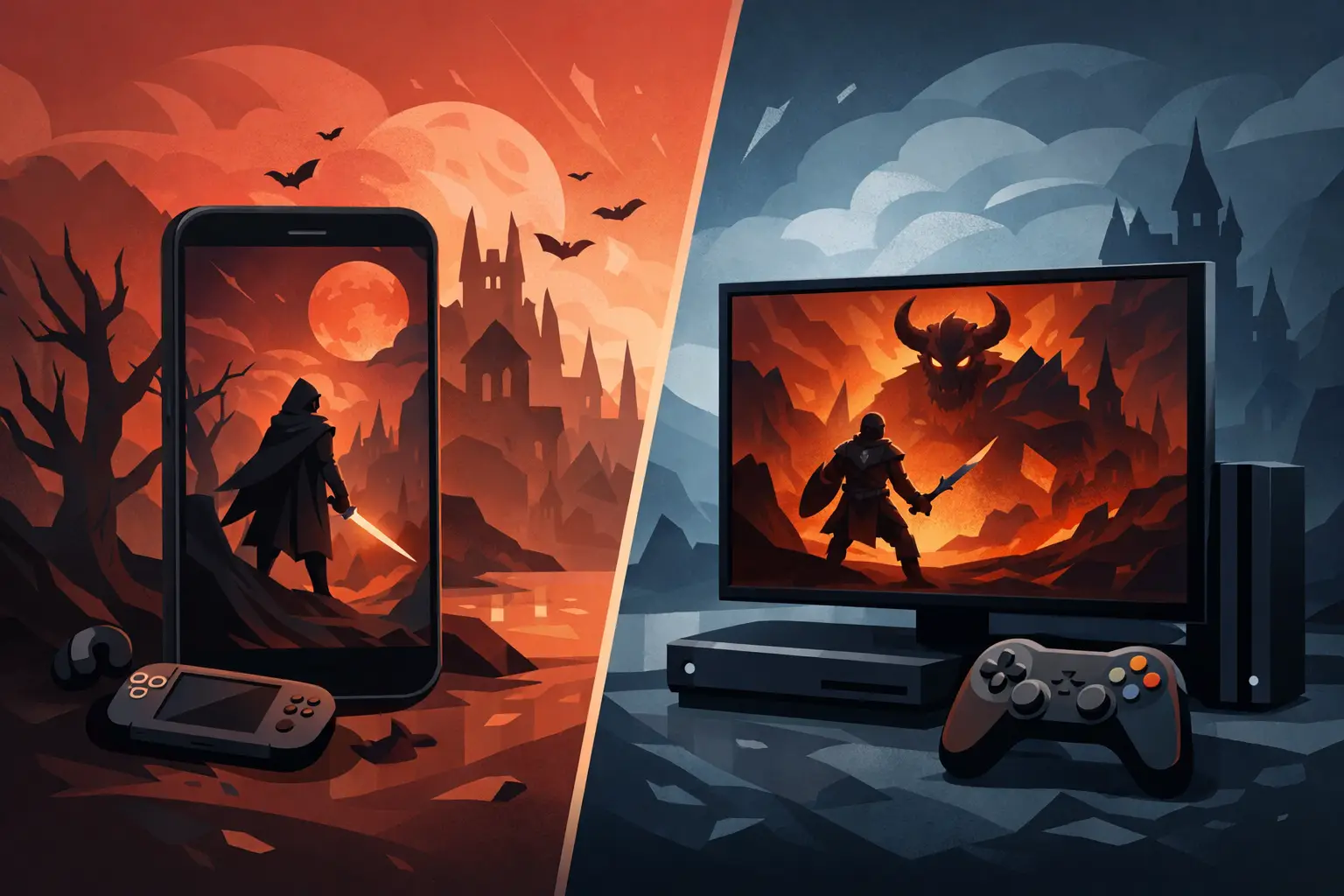
A ruined kingdom does not wait for a free evening. Sometimes you have ten quiet minutes before work, a train ride through the rain, or a final moment before sleep to strengthen a Familiar and prepare a formation. That is where mobile versus console RPGs becomes more than a question of screen size. It is a question of how, when, and why you enter a world at war.
Both platforms can deliver memorable characters, brutal choices, sprawling lore, and battles that demand thought. Yet they ask different things of the player. Console RPGs often claim your full attention for long sessions. Mobile RPGs are built to keep the campaign alive between those sessions, turning steady decisions and long-term growth into part of everyday life.
For dark fantasy players who care about collection, tactical teams, and the slow rise of power, neither format automatically wins. The better choice depends on the kind of Warlord you want to be.
Mobile Versus Console RPGs: The Real Difference
The familiar argument says console games offer depth while mobile games offer convenience. There is truth in it, but it leaves out too much. Depth is not measured only by map size, voice acting, or the number of hours before the credits roll. A game can create depth through difficult combat inputs, branching dialogue, party builds, resource decisions, or the long work of evolving a roster over months.
Console RPGs usually place the player inside a concentrated experience. You sit down, take direct control, and move through a crafted campaign. A battle may demand precise timing, movement, menu commands, or tactical positioning. The world is often designed around immersion: large environments, cinematic scenes, detailed sound, and the expectation that you will remain present for a while.
Mobile RPGs shape their depth differently. They are designed around repeated contact with a living world. You may claim resources, improve equipment, adjust a formation, capture an enemy, enter an event, and return later to see what your decisions have changed. The strongest mobile RPGs are not merely smaller console games. They are ongoing strategy games built around a device already in your hand.
That difference matters because a player with two hours every few nights has different needs from one who can play in shorter windows throughout the day. Neither rhythm is lesser. They serve different lives.
What Console RPGs Do Best
A console RPG is often the right choice when you want to disappear into a single journey. Its strengths come from focus. A controller gives every action a physical weight, whether you are parrying a monstrous strike, navigating a dangerous ruin, or selecting a spell under pressure. Larger displays and stronger hardware can also make a decaying capital or cursed battlefield feel imposing in ways a phone cannot always match.
Narrative pacing is another advantage. Console RPGs can hold a player inside a long scene, then let silence settle over an empty road before the next threat appears. There is less pressure to fit every interaction into a brief session. For players who value cinematic storytelling, manual exploration, and a definitive ending, that structure is powerful.
But console play has a cost: access. A rich campaign can become difficult to maintain when work, school, travel, or family breaks the rhythm. Returning after a week away may mean remembering a dozen systems, a half-finished quest, and the name of the traitor you were meant to hunt. A console RPG rewards commitment, but it often asks for it in larger pieces.
Why Mobile RPGs Earn Their Place
Mobile RPGs are at their best when they respect limited time without treating the player’s choices as meaningless. A short session should still move the account forward. A longer session should reveal more to optimize, challenge, or pursue.
Hero-collector RPGs are especially suited to this structure. Building a roster is a long campaign in itself. Each new character can change what a team is capable of, while duplicates, evolutions, equipment, skills, and faction relationships create reasons to revisit older units. The pleasure is not only in gaining power. It is in finding the combination that turns a struggling formation into a force that can survive.
Automated combat can make that strategy clearer rather than shallow it. When battles resolve without constant manual input, attention shifts toward preparation: stats, skill effects, positions, buffs, debuffs, gear, and team composition. The question becomes less about whether you can tap quickly enough and more about whether your Warlord built the right answer before the battle began.
That approach will not satisfy every player. If you want to personally dodge every blade or land every final strike, a console action RPG may be the better fit. But if you enjoy planning a formation, studying why it failed, and making deliberate adjustments, automation can turn combat into a contest of judgment.
In Blood Legends RPG, that judgment lives in the Contracts you form, the Familiars you recruit, and the formation you send toward the Gates. Progress is not only a number rising on a screen. It is a record of choices made while corruption spreads and old powers begin to fracture.
Progression: A Finished Tale or a Living War
Console RPG progression commonly moves toward completion. You gather allies, confront a central threat, reach an ending, and perhaps return for optional bosses or a new playthrough. That arc can be deeply satisfying because it has a shape. The story starts somewhere, descends into danger, and eventually closes its gates.
Mobile progression is usually more open-ended. New events, raids, characters, and multiplayer seasons can keep changing the battlefield. A player might spend one week refining a team for a raid boss, then shift focus when an event introduces a new enemy type or a more valuable reward path. This creates momentum, but it also means players should choose games that communicate clearly about systems, rewards, and development.
Live-service design carries a responsibility. New content should add meaningful decisions, not simply raise the number required to compete. Strong updates give established players new uses for their collections while giving newer players realistic paths to grow. A healthy community depends on that balance. Veterans need challenges worthy of their work, while fresh Warlords need a reason to believe the war is still survivable.
Controls, Attention, and the Shape of Strategy
Controls are not a minor detail in mobile versus console RPGs. They determine what kinds of challenge feel fair.
A console controller is built for sustained, precise action. It supports fast camera movement, complex shortcuts, and demanding encounters. This makes console RPGs a natural home for action combat, exploration-heavy worlds, and games where reflexes carry equal weight with character builds.
A phone has a smaller screen and touch controls that must compete with real life. Notifications arrive. A commute ends. A connection weakens. Good mobile RPG design accepts those limits rather than pretending they do not exist. Menus should be readable, daily tasks should not become chores, and important tactical choices should remain understandable without a keyboard full of commands.
Mobile play also makes asynchronous progress feel natural. You can make a quick equipment change, collect rewards, inspect the Bazaar, or set up a team before putting the device away. Real-time multiplayer and raids can still provide moments of intensity, but the game does not have to demand an uninterrupted evening before it offers something worthwhile.
Choosing the Right RPG for Your Time
Choose a console RPG when you want a deliberate escape: a long session, direct control, rich audiovisual immersion, and a story that may one day reach a final page. It is the stronger format for players who want to inhabit a single adventure without checking in every day.
Choose a mobile RPG when you want an RPG world that can travel with you. It fits players who enjoy collecting heroes, testing formations, building power gradually, and returning to an evolving conflict with friends or rivals. The best sessions may last five minutes or fifty, but both should matter.
Many dark fantasy fans will want both. A console campaign can be the cathedral you visit when the night is long. A mobile RPG can be the sealed letter in your pocket, reminding you that the war continued while you were away.
The useful question is not which platform is more legitimate. Ask which kind of commitment you can actually sustain, then seek a world whose battles reward that commitment. A well-chosen RPG should leave you eager to return to your Warlord, not guilty for stepping away.