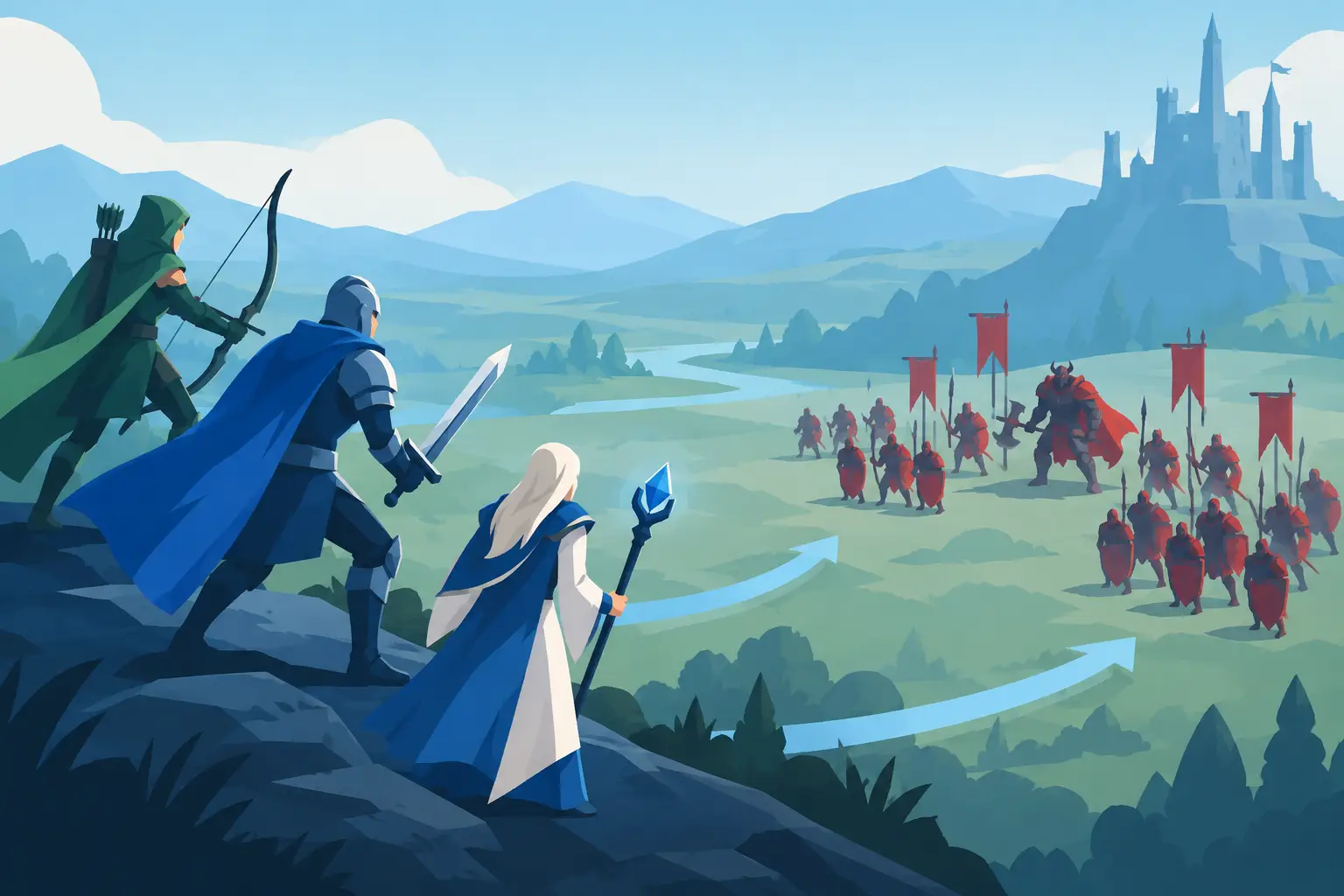
A battle can be lost before the first skill is cast. Your strongest Familiar may carry devastating power, but if it stands where the enemy can tear it apart in the opening seconds, that power never reaches the field. Learning how to improve battle positioning means treating every formation slot as a decision about survival, targeting, timing, and sacrifice.
Combat is automated, but it is never without command. A Warlord who understands the formation decides who absorbs the first blow, who remains untouched long enough to cast, and which enemy threat is allowed to live.
Positioning Is a Plan, Not a Power Score
It is tempting to place your highest-rated Familiars together and trust their stats to carry the fight. That approach can work against weak encounters, but harder stages, raid battles, and real-time multiplayer punish it quickly. A formation is not a display case. It is a chain of protection.
Start by identifying each Familiar's battlefield role. Durable defenders belong where they can receive pressure early. Fragile damage dealers need time and distance. Support Familiars need protection, but they may also need a position that lets their skills affect the allies who matter most. A character with healing, shielding, cleansing, or buffs can be more valuable than a second attacker if the formation gives them time to act.
The right setup depends on the enemy. There is no permanent formation that defeats every force emerging from the shadows beyond the Gates. A line built to withstand heavy physical attacks may collapse against enemies that bypass the front and hunt the backline. Positioning improves when you stop asking, “Who is strongest?” and begin asking, “Who must survive this fight, and who can afford to be hit?”
How to Improve Battle Positioning Before a Fight
Before changing slots at random, inspect the threat in front of you. Look for the enemy's toughest unit, their most dangerous damage source, and any support unit that extends the battle. Then build around the first several moments of combat.
If the enemy's pressure lands on the front, place your toughest Familiar there, not simply the one with the highest level. Defense, health, mitigation, self-healing, and control resistance all matter. A frontliner that survives with little damage dealt has still done its work if it bought enough time for your backline to cast decisive skills.
If the enemy can strike several targets at once, avoid clustering every fragile Familiar in the same vulnerable area when your available formation allows separation. If an enemy assassin or targeting effect reaches the rear, a lone support unit may become an easy execution. Sometimes the answer is a sturdier backline companion. Sometimes it is a faster attempt to eliminate that threat first. The correct answer depends on your roster and the encounter's targeting behavior.
Do not overlook skill timing. A Familiar whose first skill shields allies or disrupts enemies may deserve greater protection than a damage dealer with a slower impact. In automated combat, placement is one of the few ways to influence whether critical abilities happen before the formation begins to fail.
Build a Frontline With a Purpose
The frontline is not merely where you place your toughest two Familiars. It is where you decide how the enemy spends its opening attacks.
A dedicated defender can hold the line while damage dealers work from safety. Pairing that defender with a bruiser can be effective when you need additional pressure without abandoning durability. But two offensive units in front often create a dangerous illusion: fights begin quickly, damage rises quickly, and then the team disappears just as quickly when a stronger enemy answers.
A good frontline should do at least one of three things: absorb damage efficiently, control enemy actions, or punish enemies for attacking it. If it does none of these, it may be consuming a valuable protective slot without creating an advantage.
There are moments when an unconventional frontline is correct. If a particular Familiar has a powerful opening control effect or gains value when targeted, placing it forward can disrupt an enemy plan. That is a calculated risk, not a default. Test it against the same encounter more than once. A formation that wins through one fortunate sequence is not yet reliable.
Protect the Familiar That Changes the Fight
Every team has a piece that changes the battle if it remains alive long enough. It may be a high-damage attacker, a healer, a debuffer, or a Familiar whose Blood Bond skills turn a stalled fight in your favor. Find that piece and build a wall around it.
Protection does not always mean hiding it as far back as possible. A support Familiar may need a particular placement to reach key allies, while a damage dealer might need protection from a specific enemy angle. Read the result of each loss carefully. If the same Familiar dies first every time, the formation is telling you where it has fractured.
Use the Backline for More Than Damage
The backline is where many formations either become dangerous or become greedy. Filling it only with glass-cannon attackers may create impressive early damage, but it leaves no recovery when the enemy breaks through or lands widespread attacks.
Consider balance. One protected support Familiar can extend the life of two attackers. A debuffer can make a heavily armored enemy vulnerable. A control-focused Familiar can stop an opposing carry from acting at the worst possible moment. Their value may not always appear as the largest number on the battle report, but it can decide the outcome.
This does not mean every team needs the same ratio of defenders, attackers, and support. Fast farming encounters may reward a more aggressive setup. A raid boss with punishing sustained damage may demand endurance and healing. Competitive battles often reward flexibility because opponents can expose a predictable formation. Positioning is strongest when it serves the objective, not when it follows a fixed recipe.
Let Defeat Reveal the Weak Point
When a battle fails, resist the urge to immediately raise levels or replace the entire team. First, identify the moment the fight turned.
Did your defender fall before support skills activated? Strengthen that frontline, adjust its equipment, or move a second durable Familiar into a protective role. Did an enemy attacker destroy your backline? Reconsider who is exposed and whether your team has enough control or counterpressure. Did the battle drag on until healing and shields could not keep up? You may need more damage, stronger debuffs, or a target priority change rather than more defense.
Use repeated attempts as controlled tests. Change one meaningful element at a time: a frontline swap, a support position, a new equipment choice, or a different Familiar. If you change everything at once, you may win without knowing why. Understanding the reason matters, because the next corrupted host will demand another answer.
Positioning Must Grow With Your Roster
As you recruit, evolve, empower, and deepen Blood Bonds, your formation should change with your collection. An early-game defender may eventually be replaced by a Familiar with better mitigation, stronger control, or more useful team synergy. A newly evolved attacker may deserve greater protection because its scaling has made it the center of your damage plan.
Equipment changes the equation as well. A Familiar built for durability can take risks that a lightly equipped version cannot. A fast, high-impact caster may need only a brief window of safety. Do not copy a formation blindly from another Warlord unless you can match its skills, equipment, and progression. The shape may be useful, but the reason behind it is what wins battles.
Keep Your Formation Alive Between Victories
The best formation is not the one that produces the largest burst of damage. It is the one that gives your most valuable Familiars the time to fulfill their purpose against the threat in front of you. Watch who dies first, test one adjustment, and let every failed battle reveal where your line has been weakened. In a world closing in around the Gates, survival is not passive. It is arranged, slot by slot, before the battle begins.