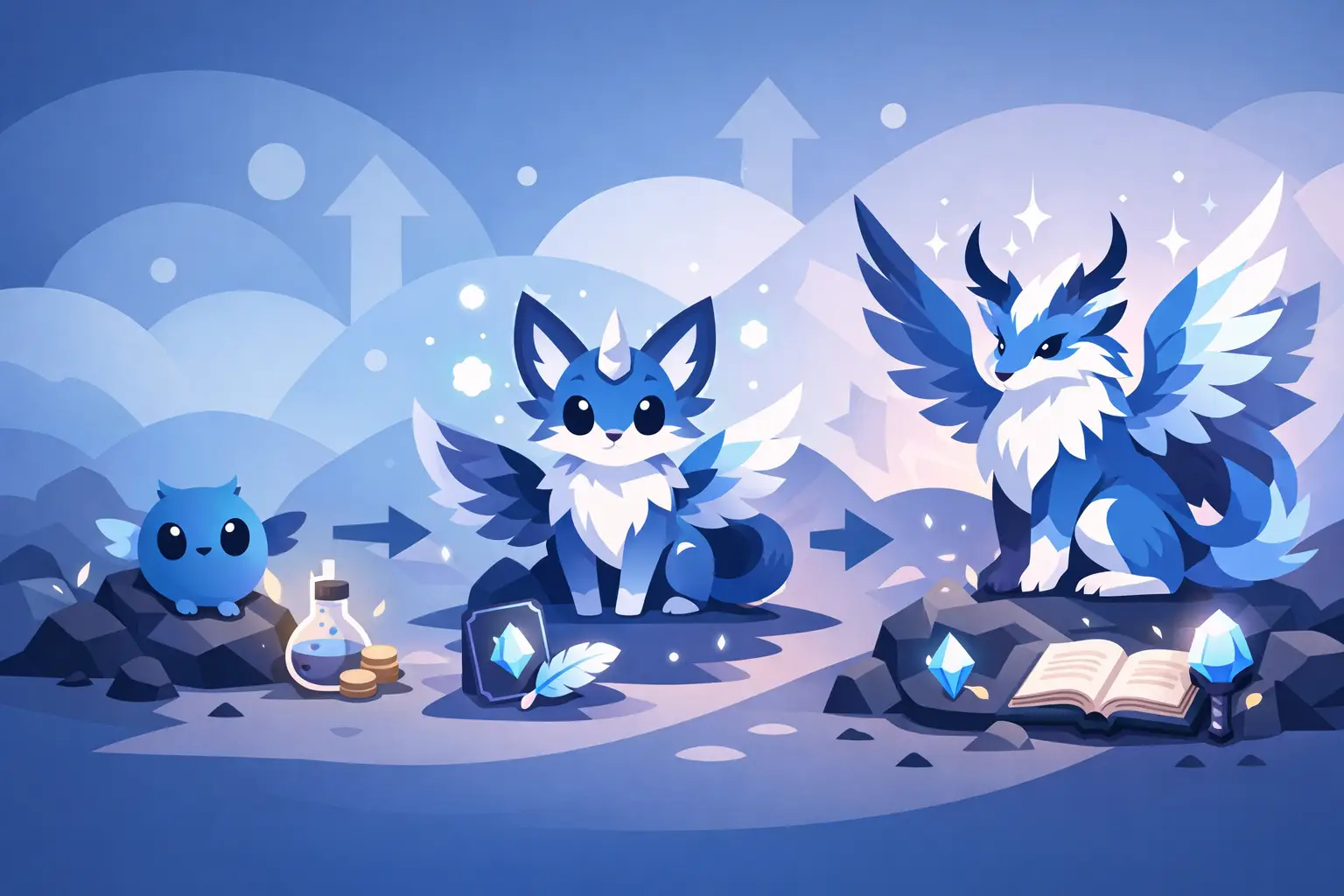
A Familiar can carry a formation through a difficult chapter, then become the reason that same formation stalls. The difference is rarely luck. Knowing how to evolve RPG familiars means recognizing which Contracts deserve rare resources, when a power spike matters most, and which creature is only borrowing a place in your ranks.
Evolution is not merely a higher number beside a Familiar’s name. It is a long-term decision that shapes your damage, survival, skill access, and formation options. In a world scarred by corruption and ancient Gates, every resource spent should help your Warlord endure what waits ahead.
What Familiar Evolution Actually Changes
In most hero-collector RPGs, evolution raises a Familiar’s base potential. That usually means stronger core stats, higher level limits, improved skill scaling, or access to further progression systems. A Familiar that has reached its current ceiling may still look useful on the roster screen, but it will eventually fall behind enemies whose health, defenses, and damage continue to rise.
The exact requirements can differ by Familiar and progression tier. Some evolutions demand duplicates, while others require specific materials, captured creatures, gold, or a mixture of each. Treat those requirements as a warning, not an inconvenience. The rarer the cost, the more carefully you should judge the result.
Evolution also changes the value of a Familiar inside automated combat. Since battles are decided by stats, skills, position, buffs, debuffs, equipment, and team composition, a stronger Familiar is not automatically the correct Familiar. A fully evolved attacker placed where it dies before casting may contribute less than a lower-tier support protected by a proper frontline.
How to Evolve RPG Familiars at the Right Time
The best time to evolve is when the upgrade answers a real obstacle. If campaign enemies are surviving your opening rotation, an evolved damage dealer may break the wall. If your frontline collapses during raid battles, evolving a defender or healer may be worth more than improving a second attacker.
Do not evolve simply because the button is available. Early resources often arrive quickly, creating the illusion that every decision is reversible. Later, when you need materials for a high-value Familiar, that old impulse becomes expensive. Save enough resources to react when a core unit reaches a meaningful threshold.
A practical rule is to evolve when at least one of these conditions is true: the Familiar is part of your main formation, it has proven useful across several modes, or its next evolution directly improves a skill or stat your team lacks. If none apply, wait. A resource held in reserve is not wasted. It is a choice preserved.
Evolve your core formation before your collection
Collectors naturally want every Familiar to grow. That instinct is part of the pleasure of building a dark fantasy roster, but progression favors focus. Your main formation needs a dependable damage source, enough protection to keep key units alive, and utility that disrupts enemy plans.
Start with the Familiars you deploy most often. A powerful carry, a durable frontline anchor, and a support whose buffs, healing, control, or debuffs affect the whole team are usually stronger investments than a character used only for one niche encounter.
This does not mean every formation should look the same. A raid team may value sustained damage and survivability, while multiplayer can reward control, speed, disruption, or a counter to a popular enemy setup. Evolve the Familiar whose growth serves the mode currently blocking your progress.
Read the Familiar Before You Spend
Before committing materials, inspect the Familiar as if you were choosing who stands beside your Warlord at the edge of a Gate. Look beyond rarity and current power. Study the role, skills, stat tendencies, equipment needs, and relationship to the rest of your formation.
A high-damage Familiar with weak defenses may be excellent when protected by a taunting frontline or shield support. The same Familiar can be a poor investment if your team has no way to keep it alive. Likewise, a defensive unit may look modest in solo content but become essential when its mitigation allows your backline to cast repeatedly.
Pay close attention to skill scaling. An evolution that strengthens a central ability can be far more valuable than one that only adds a small amount of raw power. Damage-over-time effects, crowd control, healing, shields, armor reduction, and team buffs all gain value when they interact with the rest of the formation.
Blood Bond planning belongs in this decision as well. If a Familiar is close to unlocking a skill that completes its role, evolution may be the bridge that makes the entire investment worthwhile. If its future unlocks do not help your current strategy, consider preserving those resources for another Contract.
Duplicates, Materials, and the Cost of Regret
Duplicate Familiars can feel like an insult after a hard summon or capture. They are often the price of greater power. Before consuming one, confirm whether it is needed for evolution, whether it has trade value, and whether holding it gives you flexibility for a future build.
The Bazaar adds another layer to the decision for eligible Familiars. A duplicate that does little for your current roster may still be valuable to another player, while a needed evolution piece may be worth obtaining through trade rather than more summons. The right move depends on scarcity, your immediate goals, and how difficult the Familiar is to replace.
Avoid feeding valuable duplicates into temporary units just to gain a small early advantage. This is especially tempting after a difficult loss streak. Yet a short-term boost can delay a major evolution for days or weeks. Spend common materials freely enough to maintain momentum, but treat rare duplicates and limited event rewards with suspicion until you know their full purpose.
Build Around Evolution, Not After It
An evolved Familiar should change how you think about the formation. After upgrading a carry, ask whether its position is safe and whether allies amplify its damage. After evolving a tank, ask whether moving a fragile support behind it creates a stronger defensive line. After improving a debuffer, ask whether your damage dealers can capitalize on the window it creates.
Automated combat rewards preparation over reflexes. You cannot rescue a misplaced Familiar with a last-second command. Positioning and team order must do that work before the battle begins. Test your evolved unit in campaign stages, raid attempts, and multiplayer matches rather than judging it from a power rating alone.
When results disappoint, change one variable at a time. Try a new position, exchange one support, adjust equipment, or test against a different enemy composition. If you alter everything at once, you will not know whether the evolution failed to help or whether the formation was simply built poorly around it.
Common Evolution Mistakes
The first mistake is spreading materials across too many Familiars. A broad roster has value, but a weak roster cannot push difficult content. Build one reliable core before investing heavily in experiments.
The second is chasing rarity without considering function. A rare Familiar can be powerful, but a well-supported lower-rarity unit with the right skills may do more for your current team. Rarity signals potential, not immediate fit.
The third is ignoring future costs. Before evolving, check what comes after the next tier. If a Familiar will demand rare materials again soon, plan for that path instead of reaching the next milestone only to stop there.
Finally, do not judge an evolution solely by a single defeat. Some encounters are designed to expose a weak formation, missing debuff, poor position, or unsuitable damage type. Evolution improves a piece of the warband. Strategy decides whether that piece has a place to fight.
Let the Roster Earn Its Power
In Blood Legends RPG, a Familiar is more than a collectible silhouette in the dark. It is a Contract that may become the center of a formation, the answer to a raid boss, or the survivor who holds the line when corruption closes in. Let each evolution serve that future, and your strongest Familiars will feel earned rather than merely upgraded.