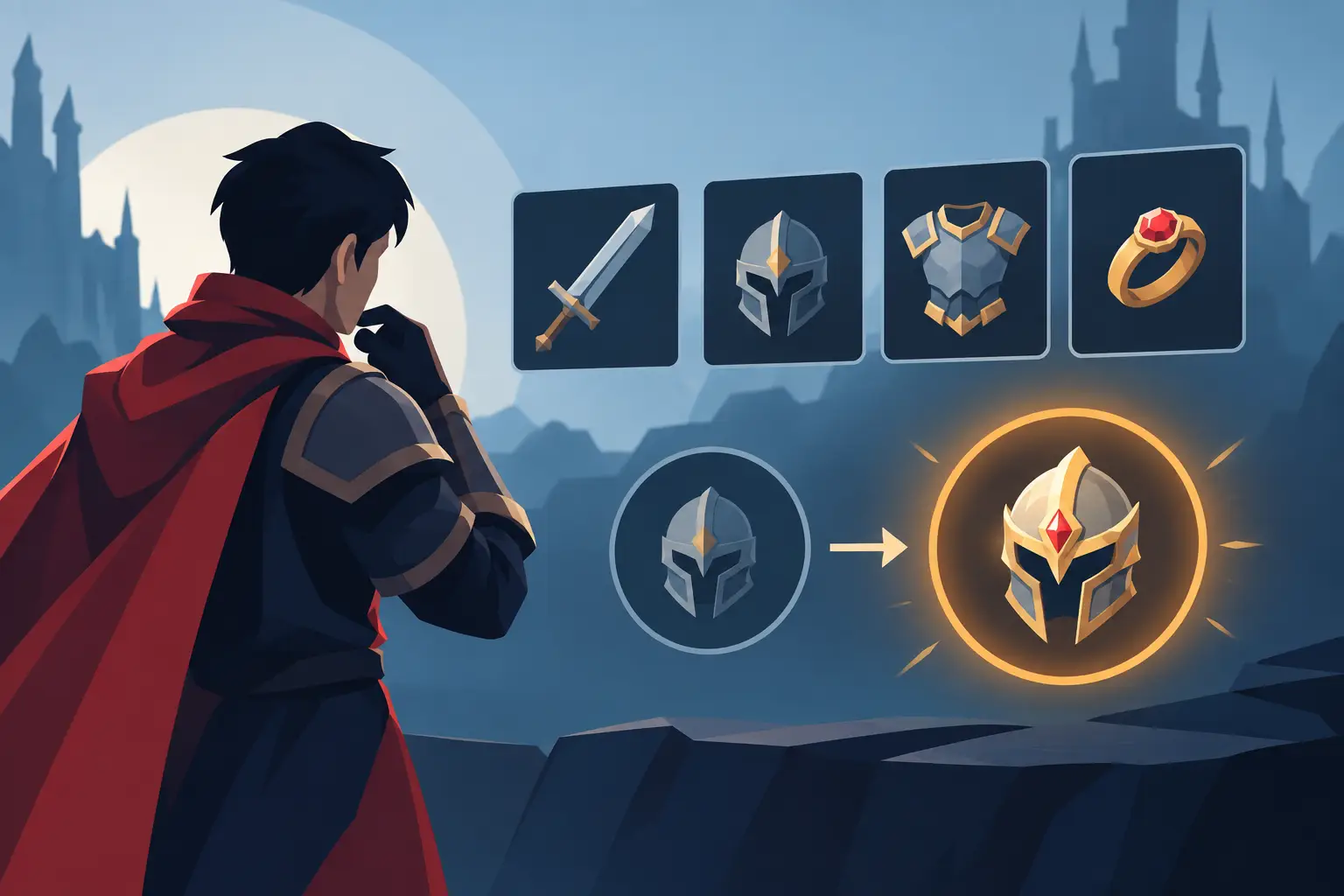
A rare weapon drops after a difficult battle, its numbers higher than the gear on your strongest Familiar. The instinct is simple: feed it every resource you own. That is how materials vanish, power stalls, and a formation built for one fight fails at the next. Knowing how to choose gear upgrades means looking beyond rarity and asking a harder question: which investment helps your whole formation survive what is coming?
In Blood Legends, equipment is not a separate path from strategy. It is part of the contract between Warlord, Familiar, position, skills, and formation. Automated combat makes that connection even more severe. Once battle begins, there is no last-second correction. Your upgrades must already support the plan.
How to Choose Gear Upgrades Before Spending Resources
Start with the role a Familiar serves in your current formation, not with the color or rank of the gear. A front-line protector, a damage dealer, and a support Familiar can all benefit from upgrades, but not from the same ones and not at the same moment.
A durable front-line Familiar usually gains more from survivability than a small damage increase. If it falls before the back line can work, the entire formation breaks open. A main attacker may need offensive stats to cross an enemy's defensive threshold, especially in battles where drawn-out combat lets enemy healing, shields, or escalating effects take control. Support Familiars often need the stats that keep their abilities active long enough to matter.
The question is not, “Is this gear stronger?” Ask, “What problem does this solve in my next difficult battle?” If your team is dying too quickly, reinforce the point of collapse. If enemies survive with a sliver of health, improve the source of reliable damage. If a key Familiar is disabled or removed before using its strongest skill, invest in the stats that help it remain on the field.
This approach prevents the most common trap in progression games: spreading upgrades across every piece of gear because each improvement feels useful. Small gains everywhere can look impressive on a roster screen while changing nothing in combat. Focused gains on the Familiars carrying your formation are far more likely to move a stalled campaign stage, raid attempt, or multiplayer match.
Upgrade the Formation You Actually Use
Most players have more Familiars than they can fully equip. That is not a weakness. Collection is part of the long road, and new recruits may become valuable when a new enemy, event, or formation calls for them. But early and mid-progression resources are rarely endless. Build a core group first.
Choose a primary formation that can handle most content, then give its gear priority in a clear order. Your lead damage source and the Familiar absorbing the most pressure are often the first candidates. After that, invest in the support or secondary damage role that makes the formation function. The exact order depends on your battles: a fragile attacker may need protection before more damage, while an unkillable defender may offer little value if the team cannot finish enemies.
Do not upgrade for a Familiar you only use because its power number is high. Watch the fight. A Familiar with a lower visible score may be carrying the battle through control, healing, debuffs, or placement. Likewise, a powerful-looking attacker that dies at the first enemy burst may not deserve another costly weapon upgrade until its protection is solved.
There is value in keeping a small reserve of gear and materials for a second formation or specialized counter. Real-time multiplayer, raids, and changing event conditions can punish a roster built around one answer. Still, a reserve is not the same as equal investment. Give your main formation the strength to progress, then widen your options when that foundation is secure.
Match Gear Stats to Position and Purpose
Positioning gives gear decisions context. The same upgrade can be decisive on the front line and nearly wasted in the back.
Front-line Familiars are exposed first. Defensive stats, health, resistance, mitigation, or other survival-focused effects usually gain value here because they buy time for the rest of the formation. Yet pure durability is not always the answer. A front-line Familiar whose skills scale with offense, retaliation, or control may need a balanced build. The goal is not to create an immortal wall. It is to create a wall that contributes before it falls.
Back-line damage dealers need enough protection to avoid being erased by enemy pressure, but their gear should still serve their damage pattern. A Familiar built around repeated attacks may value different stats than one whose threat comes from a single devastating skill. Read the skill behavior, then make the gear reinforce it. Numbers only matter when they improve the part of the kit that wins fights.
Support Familiars deserve the same attention. It can be tempting to give them leftovers because they are not dealing the final blow. That can be costly. If a support Familiar provides healing, buffs, debuffs, or control, its ability to act consistently may be worth more than another minor offensive upgrade elsewhere. A dead support provides nothing, no matter how perfect its skill kit looked in the collection screen.
When gear offers conditional effects or bonuses, test them against your formation rather than assuming they are universally strong. A bonus that relies on a certain health state, attack pattern, position, or team condition may be exceptional in one setup and dormant in another. Gear should sharpen a strategy you already understand, not force your team into a strategy it cannot sustain.
Treat Upgrade Materials Like a War Chest
The darker the battles become, the more expensive bad decisions feel. Before committing scarce materials, compare the upgrade against the alternatives. Could the same investment improve a key skill, evolution, Blood Bond milestone, or another Familiar's essential gear? There is no universal answer, but there should be a reason for every major spend.
A good rule is to invest heavily when an upgrade has immediate impact, long-term usefulness, and a clear owner. Immediate impact means it addresses a barrier you face now. Long-term usefulness means the Familiar is likely to remain in your core formation through upcoming progression. A clear owner means you know why that piece belongs on that Familiar instead of being passed around every time the roster changes.
Be more cautious with gear that is merely temporary. Early pieces can carry a Familiar through a difficult stretch, and modest upgrades may be justified if they unlock progress. But pouring rare materials into gear you expect to replace soon can delay a more meaningful power spike later. Temporary gear should earn only the resources needed to do its job.
This is where patience becomes a competitive advantage. Save enough materials to respond when a better piece appears or when a newly evolved Familiar changes your formation. Players who spend everything the moment they receive it often have no answer when the Gates open to a tougher threat.
Use Battles to Test, Not Just to Farm
Gear theory has limits. A stat increase that looks perfect on paper may not change the outcome if enemies are defeating you through a different weakness. After a meaningful upgrade, replay the content that stopped you and pay attention to the battle sequence.
Did your front line survive long enough for your damage dealer to use another skill cycle? Did the enemy healer fall before restoring the team? Did your support Familiar remain alive long enough to apply its crucial buff or debuff? Those answers tell you whether the upgrade worked.
If the result barely changes, do not keep feeding resources into the same piece out of pride. Shift your attention. The obstacle may be formation order, team composition, Familiar level, skills, or an enemy mechanic that demands a different answer. Equipment is powerful, but it cannot repair every weakness alone.
Raids and multiplayer deserve extra caution because their demands can differ from story battles. A gear choice that clears ordinary enemies quickly may fail against a boss built for endurance, or against another Warlord whose formation punishes your usual position. Keep notes in your own way, even if it is only remembering which Familiar fell first and why. The battlefield reveals more than a power rating ever will.
Know When Not to Upgrade
Sometimes the strongest decision is to wait. Hold resources when you are close to recruiting or evolving a Familiar that may replace a current role. Wait when you have not identified why you lost. Pause when an upgrade is too small to change a meaningful threshold.
Waiting is not wasted progression. It is preparation. The world beyond the Gates does not reward a Warlord for having the most upgraded inventory. It rewards the formation that endures, adapts, and strikes when the corruption leaves an opening.
Before your next major upgrade, run one battle with intent. Find the first point where your formation fractures, then spend to mend that wound - not the one that merely looks most impressive.