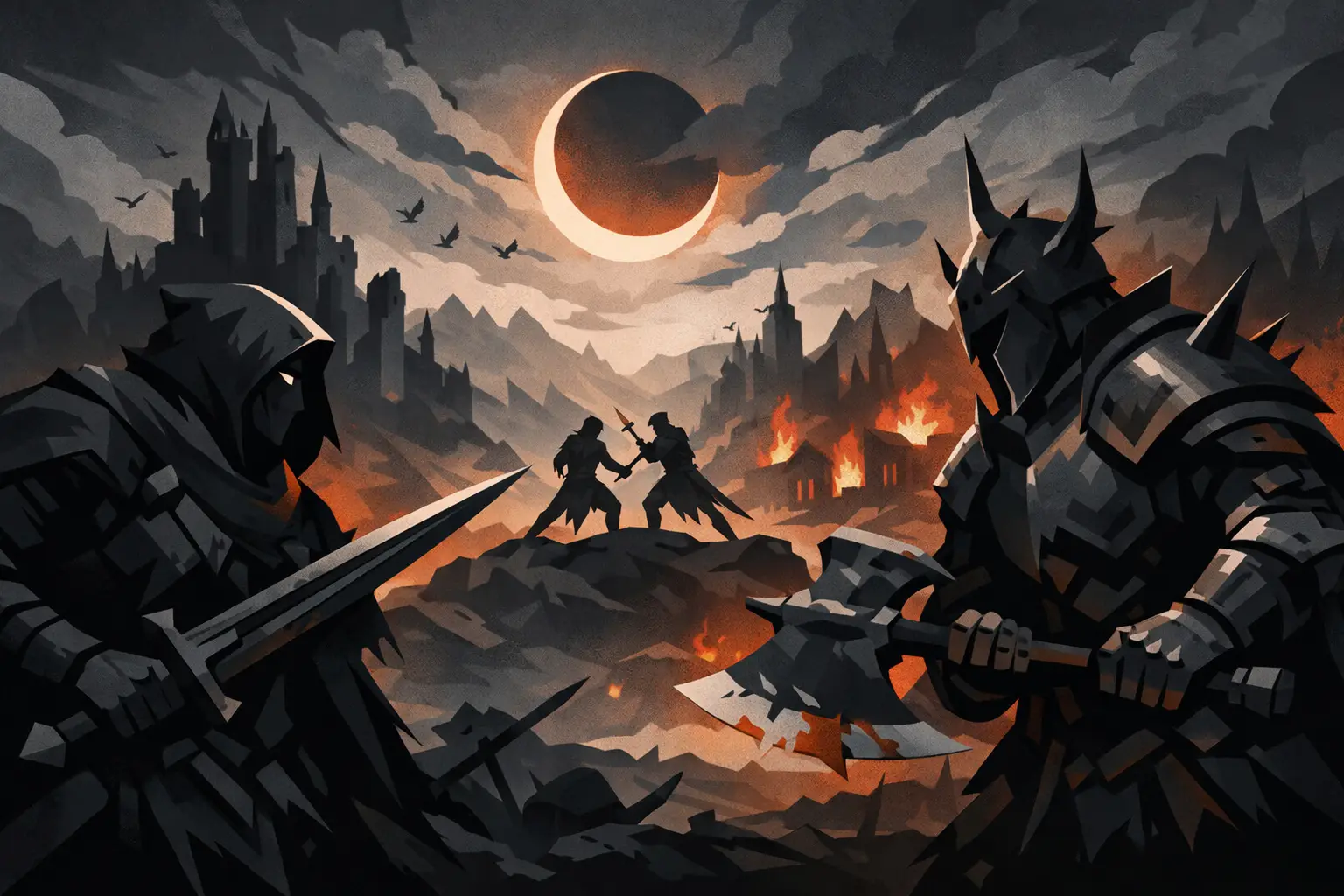
A battlefield means little if it exists only to hand out rewards. Dark fantasy game lore gives every clash a shadow behind it: a city already breaking under siege, a bloodline damaged by corruption, a gate that should never have opened. When players understand what is being lost, victory stops feeling like a number on a results screen.
For a mobile RPG, that weight matters. Battles may be automated, but a Warlord's choices still decide who stands in the formation, which Familiar receives scarce resources, and whether a fragile team can endure the next threat. Lore is what turns those choices from routine optimization into a personal campaign through a dying world.
Dark Fantasy Game Lore Begins With Consequence
Dark fantasy is not simply fantasy with black armor, ruined cathedrals, and monsters in the fog. Its power comes from consequence. Old powers leave wounds. Political promises fail. Survival asks people to choose between mercy, loyalty, and strength. Even a hard-won victory can reveal a worse danger waiting behind it.
The most compelling worlds do not explain every mystery at once. They let players notice the cost of the past in the present. A village may be abandoned not because the map needs an empty zone, but because its people fled a spreading blight. A knight may wear ceremonial armor not as decoration, but as proof of a fallen order he refuses to abandon. A Familiar may be feared because its Contract carries a history no one wants repeated.
This gradual approach is especially effective in a game built around collection. New characters should feel like discoveries, not entries added to a roster. Their appearance, skills, faction, and voice can each suggest a larger conflict. The player earns fragments of truth through recruitment, story locations, encounters, and events, then begins to see how those fragments connect.
The Gates Should Feel Older Than the War
Ancient Gates are powerful because they create a question before they provide an answer. Who made them? What was sealed beyond them? Why are they opening now? A Gate is not merely a doorway to the next chapter. It is a scar in the world, a reminder that civilization was built beside forces it never truly controlled.
That scale changes the meaning of familiar dark fantasy threats. Corruption is no longer a random curse used to justify enemy designs. It can alter landscapes, fracture alliances, twist living creatures, and tempt leaders into decisions that appear necessary until the cost becomes clear. War becomes more than a conflict between banners. It becomes a struggle over who has the right to decide what survives.
There is a trade-off here. If every event is immediately presented as the end of the world, players become numb to catastrophe. Smaller losses must have room to breathe: a lost patrol, a broken Contract, a settlement that cannot be saved, a former ally who chooses the enemy. These personal failures make the larger threat credible. The world feels endangered because its people already are.
Corruption Works Best When It Seduces
Mindless corruption can create frightening enemies, but it rarely creates memorable drama. The stronger version offers something in return: power for the desperate, certainty for the afraid, revenge for the betrayed. It does not need to make evil seem noble. It needs to make the first compromise understandable.
That is where Warlords become more than commanders. They are survivors with influence, each carrying a different response to collapse. One may seek control. Another may cling to old laws. Another may accept forbidden strength because there is no army left to call upon. Their permanent place in a player's journey makes those perspectives especially valuable. Choosing a Warlord can feel like choosing the kind of resistance the player believes in.
Familiars Carry the World Into Combat
A Familiar should never feel interchangeable with a stronger stat line. In a dark fantasy setting, these beings can carry curses, oaths, ancestral grudges, and impossible loyalties. Their bond with a Warlord is both a source of strength and a source of risk.
The Contract is where lore and progression meet. Leveling, evolution, equipment, and Blood Bond skills are satisfying because they show growth, but they can also reveal what that growth costs. An evolved Familiar might regain a sealed memory. A Blood Bond might expose the origin of its power. Equipment can carry the mark of a destroyed house, a forbidden cult, or a campaign everyone wishes had ended differently.
Not every mechanic needs a paragraph of backstory. Too much text can suffocate the pace of a mobile RPG. The better approach is precision: a sharp character description, a line after an evolution, an event scene that changes how players read a familiar ability. A few well-placed details often create more mystery than an encyclopedia entry.
Blood Legends RPG is built around this tension. Warlords form Contracts with Familiars while corruption advances through a world divided by ancient Gates. Collection and progression are not separate from the setting. They are ways of gathering allies in a conflict that keeps changing shape.
Formations Tell Stories Without Stopping the Fight
Automated combat does not remove player agency. It shifts agency to preparation. Positioning a defender in the front line, protecting a vulnerable damage dealer, building around buffs or debuffs, and deciding which Familiar deserves a place in the formation are strategic choices made before the first strike lands.
Lore can make those decisions resonate. Perhaps a certain Familiar excels beside members of a faction it once served. Perhaps two characters gain power together while their dialogue suggests an uneasy truce. A raid boss may punish careless formations because its attacks reflect an old battlefield doctrine rather than a generic area-of-effect mechanic.
Still, story should support strategy, not obscure it. Players need clear skill descriptions, understandable faction signals, and readable battle feedback. If a character's lore says they are a relentless hunter but their kit behaves like a defensive healer, the disconnect weakens both systems. The strongest design makes narrative identity and combat role reinforce each other.
A Living World Needs Room for Players
Live events, multiplayer battles, raids, and the Bazaar can make lore feel alive beyond the main campaign. A limited-time event might show the fallout of a Gate breach. A raid can unite players against a creature whose existence reshapes a region. Real-time competition can carry the tension of rival factions without pretending every opponent is a villain.
Community participation works best when it has a place in the fiction. Players are Warlords, not spectators waiting outside the story. Their formations, achievements, trades, and victories can feel like part of a wider struggle. That does not require false claims that every match changes the world permanently. Honest stakes are stronger: the world evolves through new chapters, events reveal fresh wounds, and the community helps decide which threats earn attention.
A dark fantasy world should not promise comfort. It should offer purpose. Let each new Familiar, each refined formation, and each victory against impossible odds feel like one more act of defiance before the Gates open wider.