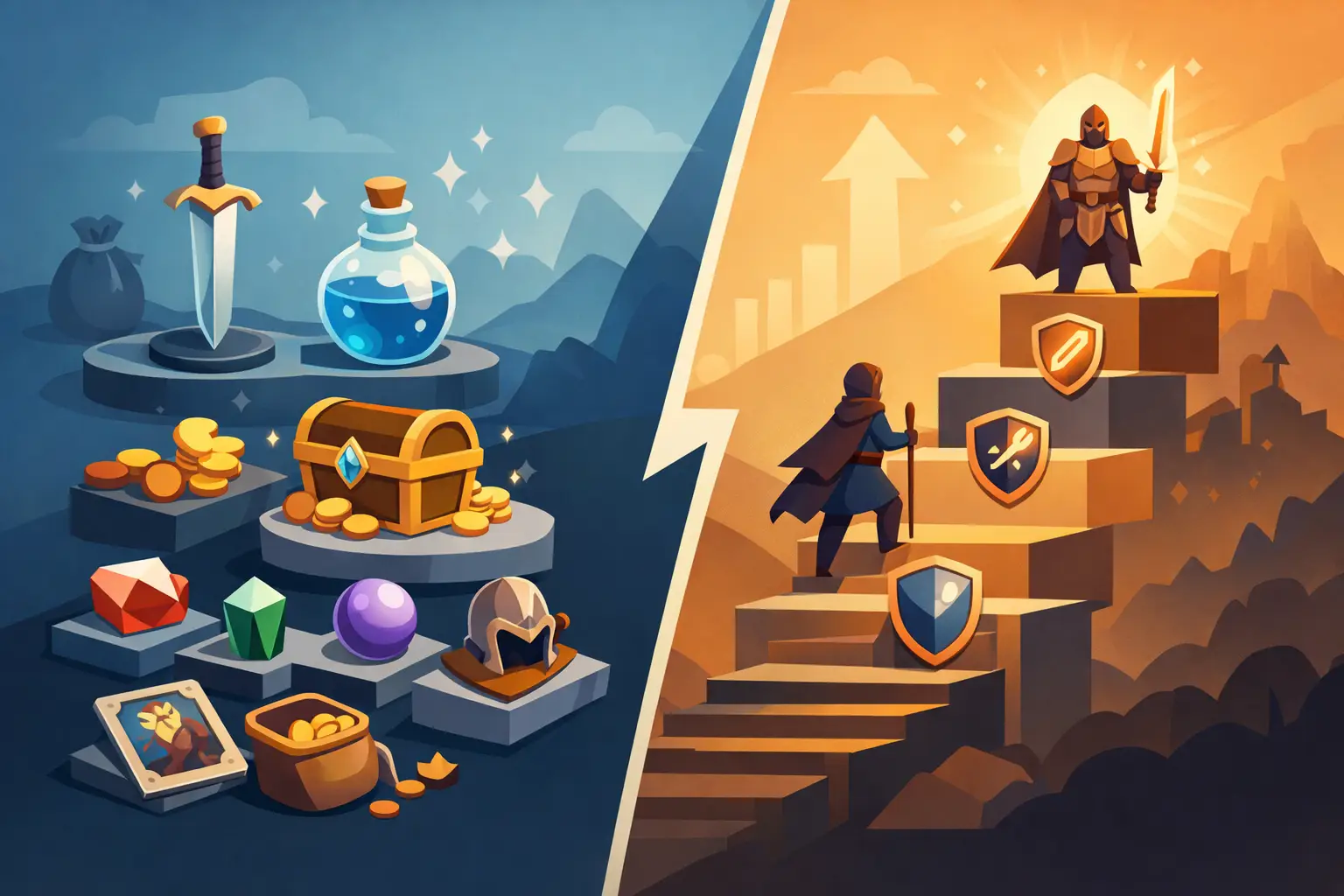
A Familiar enters your roster with a name, a silhouette, and the promise of what it could become. But possession is not power. In a dark RPG, the distance between claiming a creature and making it survive the next Gate is where the real game begins. That tension is the heart of collection versus progression systems: one gives players possibilities, while the other asks them to earn strength from those possibilities.
For a hero-collector RPG to endure, neither system can carry the burden alone. A vast roster without meaningful growth becomes a gallery. Endless upgrades without new characters to pursue becomes a treadmill. The strongest games make every summon, capture, evolution, formation change, and hard-fought victory feel connected to a larger campaign for survival.
What Collection Systems Give Players
Collection is the act of acquiring characters, creatures, equipment, cosmetics, and other permanent pieces of a game world. In a dark fantasy RPG, it is more than filling empty slots. Each Familiar can represent a new tactical answer, a fragment of forbidden history, or a dangerous ally drawn from a civilization already marked by corruption.
The immediate appeal is discovery. Players see an unknown enemy in a ruined location, encounter its abilities in battle, and begin to wonder what it could do under their command. A new Familiar might introduce a different damage type, a defensive role, a control effect, or a synergy with a Warlord's formation. The collection moment is fueled by anticipation: not simply “I own this,” but “What can this change?”
A good collection system also creates personal identity. Two players may enter the same raid, yet arrive with different Familiars, different bonds, and different ideas about what makes a formation worth protecting. One Warlord may favor relentless damage. Another may build around shielding, debuffs, healing, or a single devastating skill cycle. A roster lets players express taste as well as strategy.
Still, collection has limits. If every new character immediately replaces the last one, attachment disappears. If rare units are only stronger numbers with a new portrait, the roster becomes difficult to care about. Collection needs distinction. Familiars should feel different in their roles, skills, visual presence, and place within the world, even when they share an overall rarity or combat class.
Where Progression Creates Commitment
Progression is what happens after acquisition. Leveling, evolution, equipment, stat empowerment, skill growth, Blood Bond, and formation refinement all turn a promising Familiar into a deliberate investment. This is where a player stops asking whether a unit looks interesting and starts asking whether it can endure the fights ahead.
The best progression systems create decisions instead of chores. Resources should matter because players cannot elevate every Familiar at once. Choosing who receives the next evolution material, which skill gets improved, or which equipment set belongs on a frontline defender should reveal something about a player's strategy.
That does not mean progression should feel punishing. A Warlord who obtains a new Familiar should have a clear path to testing it, even if bringing it to endgame power takes time. Early growth needs to be understandable and satisfying. Long-term upgrades can demand patience, planning, raid participation, event rewards, and difficult choices.
There is also a narrative value to progression. A captured creature is not instantly loyal. A wounded survivor from a fallen region should not become legendary without a cost. As power rises, players should feel the weight of the world pressing back: stronger enemies, deeper corruption, and Gates that demand more than raw combat rating. Growth becomes believable when it feels earned against a threat that is also escalating.
Collection Versus Progression Systems Is the Wrong Fight
The phrase collection versus progression systems suggests a contest, but a lasting RPG treats them as a cycle. Collection creates the next question. Progression gives players the tools to answer it. Then new content introduces an enemy, event, raid, or multiplayer opponent that asks a different question entirely.
Imagine recruiting a Familiar built to weaken enemy defenses. Collection gives you access to that ability. Progression determines whether its stats and survival are sufficient for a difficult encounter. Formation strategy decides whether it can act before being eliminated. Team composition determines whether the rest of your roster can exploit the opening it creates. No single system owns the victory.
This interaction is especially important in automated combat. When battles resolve through stats, skills, positioning, buffs, debuffs, equipment, and team composition, preparation becomes the battlefield. Players need enough roster depth to adapt, but they also need enough progression depth to make choices meaningful. A shallow system turns automation into luck. A layered system turns it into strategy.
The Balance Between New Power and Old Allies
Live-service RPGs face a constant danger: the pressure to make every new release feel essential. New Familiars should be exciting, but they should not erase the worth of every ally players have spent months raising. If the latest arrival makes older units irrelevant by default, collection becomes anxiety. Players stop pursuing characters they love because they expect them to be discarded.
A healthier approach gives new Familiars a purpose rather than unquestioned dominance. Perhaps one excels against a raid boss with heavy armor. Perhaps another completes a debuff-focused formation or counters a popular multiplayer defense. These roles can be powerful without making every previous investment meaningless.
Older Familiars need room to remain useful through evolution paths, specialized equipment, Blood Bond upgrades, formation synergies, or game modes that reward varied teams. This does not require every unit to perform identically everywhere. In fact, perfect equality can flatten the roster. The goal is relevance: a reason to consider an established ally when the next threat arrives.
For players, this balance protects the emotional core of a collection game. A rare summon is exciting. So is watching an early companion, once barely able to survive, become a vital part of a disciplined formation. Both experiences matter because they tell different stories of power.
Progression Must Respect Mobile Play
Mobile RPG players often return in short windows: between responsibilities, during a commute, or before sleep. Deep progression should reward attention without demanding that every session become a spreadsheet. Clear upgrade paths, readable stat changes, and visible formation effects help players make confident choices on a small screen.
Complexity belongs in the decisions, not in needless friction. If a Familiar gains value through a particular stat, skill interaction, or team role, the game should make that relationship legible. Players can enjoy discovering advanced combinations, but they should not need to guess whether an upgrade had any practical effect.
This is also why multiple paths to growth matter. Story locations, events, raid battles, competitive play, and selective trading can all support progression in different ways. A player who prefers building a roster through exploration should still have a meaningful route forward. A competitive player should have reasons to refine formations and study opposing teams. Different activities can feed the same long-term ambition without forcing everyone into the same routine.
A Roster Should Tell the Story of Its Warlord
At its best, a collection system remembers what a player found. A progression system remembers what they chose to protect. Together, they turn a roster into evidence of a campaign: enemies captured, contracts forged, losses answered with adaptation, and power shaped under pressure.
In Blood Legends, every Familiar is more valuable when it serves a formation, every upgrade matters more when the Gates grow crueler, and every victory should leave the Warlord with a difficult choice about what to pursue next. The strongest roster is not the one with the most names in it. It is the one built with purpose when the world begins to collapse.