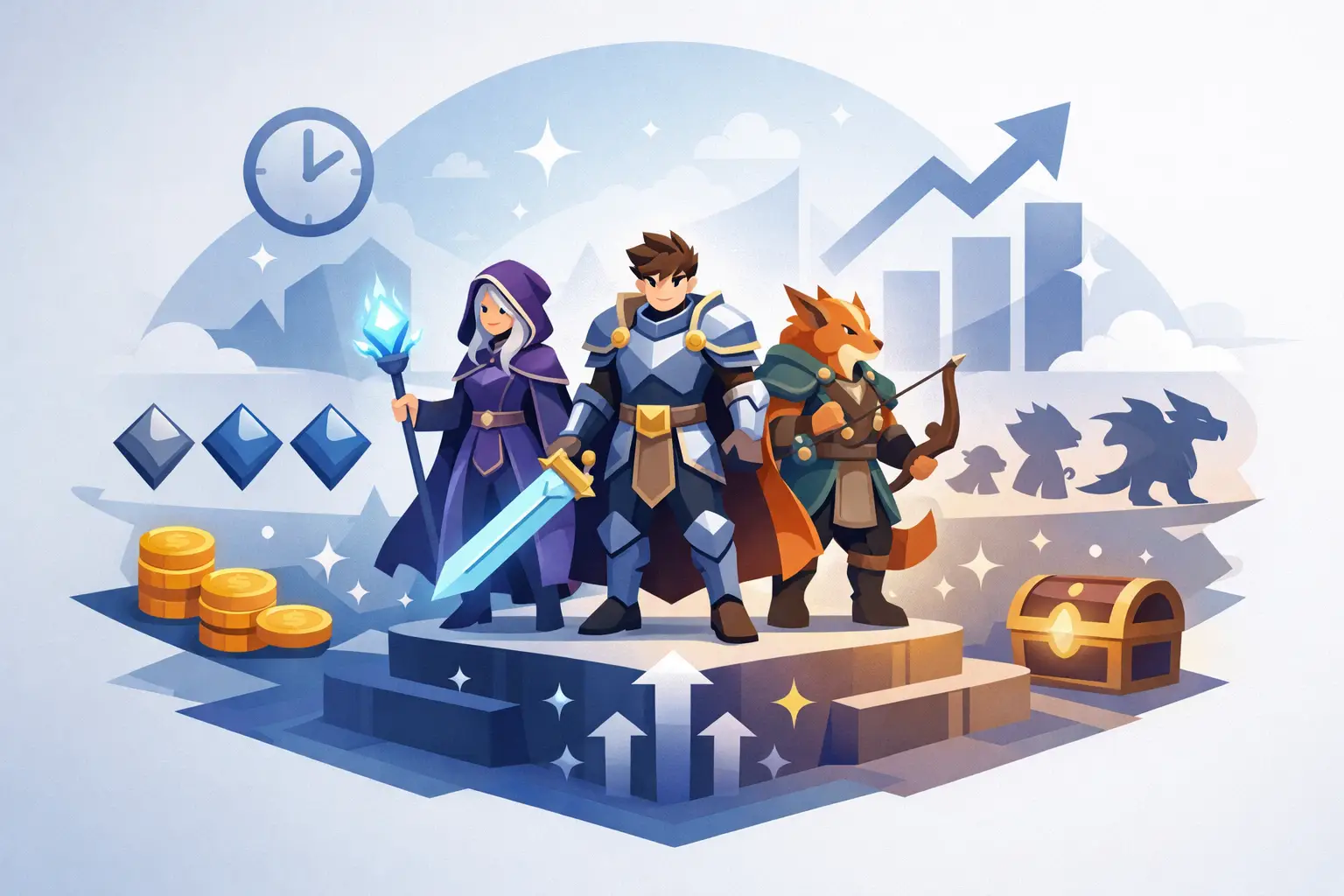
A great collect and evolve characters game does not ask players to chase a bigger number for its own sake. It gives every new recruit a place in a larger war. A Familiar may arrive weak, half-forgotten, or marked by corruption, yet careful investment can turn that creature into the piece that holds a formation together when the Gates begin to open.
That promise is why hero-collector RPGs endure. Players want the thrill of finding someone rare, but they also want to understand what that character can become. The strongest collection games turn progression into a series of decisions: who deserves resources, which abilities change a battle, and when a trusted ally should be reshaped for a harder path ahead.
What a Collect and Evolve Characters Game Must Earn
Collection alone is easy to understand. A roster grows, portraits fill in, and a new summon brings a brief surge of anticipation. But a roster without purpose becomes a vault. The characters may look striking, yet they are forgotten the moment a higher-rarity option appears.
Evolution is what gives a collection weight. When a Familiar evolves, the change should feel earned through battles, sacrifice, and deliberate planning. New power is satisfying, but meaningful evolution also creates a question: does this Familiar now fit a different role? Can it survive the front line, amplify a fragile damage dealer, weaken an enemy formation, or carry a battle that once ended in defeat?
The best systems avoid making every path obvious. One player may build for steady survival, while another pursues explosive damage and accepts the risk. Neither approach should be permanently wrong. The world is hostile, the enemy changes, and a roster built for one conflict may need to adapt when a raid boss, event challenge, or rival Warlord exposes its weakness.
A Familiar Is More Than a Rarity Color
Rarity creates excitement, but it should not erase the value of the characters players meet early. A lower-rarity Familiar with the right skill timing, debuff, or faction synergy can remain useful long after the first summons. That matters because attachment is part of the genre. Players remember the ally that carried them through a punishing chapter, even when more powerful options arrive later.
This does not mean every Familiar must perform equally in every mode. It means each should have a reason to exist. Some are specialists against armored enemies. Some protect the back line. Some create openings through control effects, while others reward a formation built around damage over time. A collection becomes strategically alive when the question is not simply, “Who has the highest power?” but “Who belongs in this battle?”
In Blood Legends RPG, Familiars are bound through Contracts to a Warlord's campaign against corruption and ruin. Their growth is not a decorative side activity. It is part of building a force capable of surviving a world where old powers are failing and the Gates have not finished taking their due.
Evolution Should Change Decisions, Not Just Stats
A stat increase is welcome. It helps a character keep pace with deeper content and makes investment visible. Yet stat growth alone rarely creates a memorable evolution system. Players need moments when a Familiar changes the logic of a fight.
That can come through an unlocked skill, a stronger passive effect, improved survival, or a new interaction with the rest of the formation. Perhaps an evolved defender can now shield allies at the moment an enemy's burst begins. Perhaps a caster's Blood Bond skill turns an existing debuff into a devastating chain. The detail will vary, but the principle remains: growth should create tactical possibilities.
There is a trade-off here. If every evolution adds too many new mechanics, players face a wall of text and lose the clarity needed for mobile play. If it adds too little, the process feels like maintenance. Strong design keeps the essential choice readable while leaving room for players who want to study skill interactions, equipment, buffs, and team composition in greater depth.
The cost of commitment
Resources give evolution its tension. If materials are unlimited and upgrades are immediate, the decision has no consequence. If they are too scarce, players become afraid to experiment and hoard everything for a perfect future that may never arrive.
A healthier balance lets players commit to a core team while still finding ways to test unusual recruits. Events, repeatable content, rewards for active play, and carefully paced progression can keep that balance alive. The goal is not to make every choice painless. It is to make the cost understandable, the reward credible, and recovery possible when a player changes direction.
Formations Give Collection Its Purpose
Automated combat is often misunderstood. Watching a battle resolve does not mean strategy has disappeared. It means strategy happens before the first strike: in the formation, the selected Familiars, their levels, equipment, skills, and the relationships between them.
Positioning matters because danger does not arrive evenly. A vulnerable attacker may need protection from the front line. A support Familiar may need to stay alive long enough to apply a crucial buff. An enemy with area damage can punish tightly packed teams, while a powerful single-target threat may demand a durable defender in a specific position.
This is where a broad roster becomes more valuable than a single all-purpose squad. A player who has collected only raw damage dealers may hit a wall against control-heavy enemies. A player who ignored healing, shielding, or debuff removal may struggle in a longer encounter. Growth feels deeper when a difficult battle sends players back to their collection with a new idea rather than a demand for more grinding.
Long-Term Progression Needs a Living World
Character evolution stays compelling when it is tied to places, threats, and events beyond a menu screen. Story-driven locations can reveal why a Familiar is fighting, what the corruption has taken, and what waits behind the ancient Gates. Raid battles can test whether a community's best formations hold under pressure. Real-time multiplayer can expose the strengths and flaws of a carefully built team in a way scripted encounters cannot.
Not every player will value the same mode. Some will focus on story and collection. Others will spend hours refining competitive formations or preparing for raid battles. A lasting mobile RPG gives these players overlapping reasons to grow without forcing one narrow definition of progress.
The live-service element matters here, but only when it respects the player's time. New events and recruits should create fresh problems to solve, not invalidate a roster built through weeks of effort. A newly released Familiar can be exciting without making every existing Contract feel obsolete. Power escalation may create short-term noise, but it weakens the satisfaction of long-term investment.
The Best Collections Tell the Player Who They Became
A completed roster is never just a count. It is evidence of decisions made under pressure. It shows which Familiars a player chose to evolve, which ones they left behind, and which strange combination became the answer to a battle that seemed impossible.
That is the lasting appeal of a collect and evolve characters game. The player is not merely acquiring heroes. They are assembling a warband from survivors, monsters, outcasts, and allies shaped by the same collapsing world. Every upgrade says something about how they fight.
When the next enemy formation blocks the path, resist the instinct to chase only the newest or rarest recruit. Look at the team already bound to your cause. The Familiar that changes the battle may be waiting in your collection, one hard-won evolution away from becoming a legend.