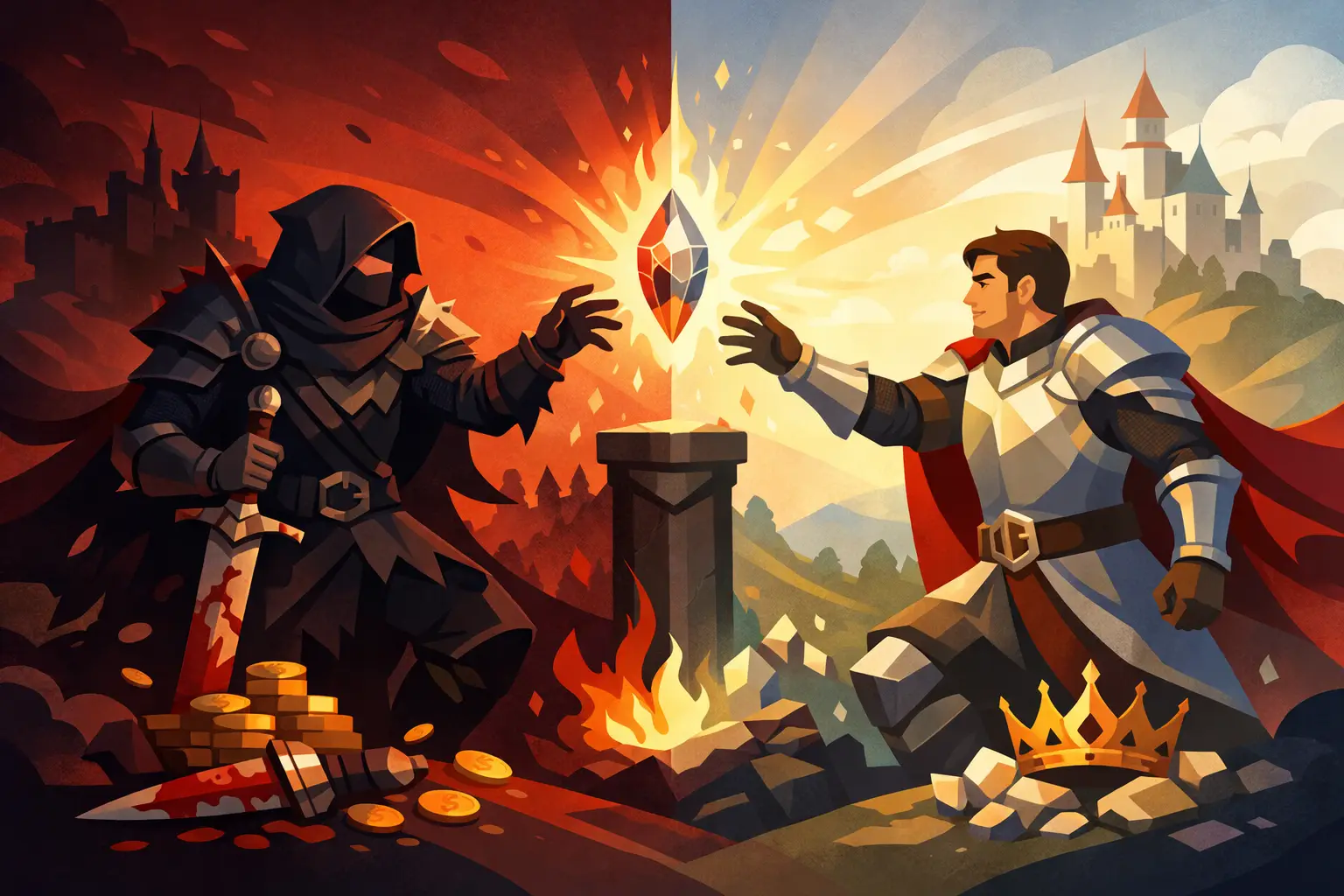
A true blood brothers rpg is not built on a single chosen hero who saves the realm alone. It is built on pacts made under pressure, allies gathered from hostile ground, and the uncomfortable truth that every new source of power may demand something in return. In a world where ancient Gates bleed corruption into failing nations, strength is never simply found. It is claimed, trained, and tested.
That is the promise at the heart of a dark fantasy hero collector. You do not merely assemble a roster because the numbers rise. You become a Warlord responsible for a living formation: the fighters who hold the line, the strange Familiars bound by Contract, and the fragile balance between offense, survival, and control. The strongest team is not always the rarest one. Often, it is the team whose pieces understand their place.
What a Blood Brothers RPG Should Demand
The phrase "blood brothers" suggests loyalty, but loyalty in dark fantasy is rarely clean. It is forged through shared danger, exile, loss, and the decision to stand beside someone when retreat would be safer. A memorable mobile RPG should carry that feeling into its systems.
Collecting characters matters most when each recruit creates a question. Does this Familiar protect a vulnerable damage dealer? Does its debuff open a path for a slower, heavier hitter? Is it worth investing scarce resources in a unit that solves a problem your current formation cannot? These choices give collection weight beyond the first summon.
Automated combat can make those decisions more visible, not less. Once battle begins, there is nowhere to hide a weak formation behind frantic tapping. Stats, skills, placement, equipment, buffs, debuffs, and team composition reveal the work done before the first strike. Victory becomes evidence that you read the battlefield correctly.
That approach also respects mobile play. A player can prepare a formation during a quiet moment, let a battle unfold, then return with a clearer sense of what failed. Perhaps the front line collapsed too quickly. Perhaps a control effect landed too late. Perhaps the squad lacked the damage to finish a dangerous enemy before its abilities turned the fight. The answer is not always to increase power. Sometimes it is to change the order of the pieces.
Warlords Are More Than a Starting Choice
Choosing a permanent Warlord should feel like choosing the hand that will shape the campaign. A Warlord is not just a portrait at the head of the screen. It is the center of a long-term identity, influencing how a player approaches growth, formation building, and the Familiars they choose to support.
There is a trade-off in permanence, and that trade-off is valuable. If every choice can be erased without consequence, the world loses tension. A permanent Warlord gives the player a reason to study their strengths and build around them rather than abandoning a path at the first difficult encounter.
That does not mean one choice should lock a player out of meaningful strategy. The best long-term systems leave room for adaptation. A defensive-minded Warlord may still form an aggressive squad with the right Familiars. An offense-first leader may survive brutal encounters through careful positioning and control. The identity remains, but the player writes its tactics over time.
In Blood Legends RPG, that relationship is carried through the Warlord and their Contracts with Familiars. The result is a team that can feel personal without becoming predictable. Two players may rely on the same central leader and still reach very different answers when corruption closes in.
Familiars Turn Collection Into Strategy
A large roster is only interesting when it creates more possibilities than clutter. Familiars need distinct battlefield purposes, progression paths, and reasons to remain relevant after the newest recruit arrives. Some will be immediate frontline answers. Others may become essential later, once an evolved skill, Blood Bond unlock, or better equipment reveals their real role.
Progression creates its own kind of story. Capturing an enemy, strengthening it, evolving its form, and seeing it earn a place in a difficult formation makes that Familiar more than an inventory entry. It becomes part of the campaign's memory. It was there when a raid boss nearly broke the team. It was the missing answer against an enemy formation that had seemed impossible.
Patience matters here. Raising every Familiar at once spreads resources thin and leaves a roster full of unfinished potential. Investing too narrowly can be just as dangerous, especially when an event, raid, or multiplayer opponent punishes a single strategy. Build a reliable core first, then develop specialists who can answer problems that core cannot.
The Bazaar adds another layer to that decision. When eligible Familiars can be traded, players must consider value from more than one angle. A Familiar may be powerful in combat, difficult to obtain, useful for a particular formation, or worth exchanging to complete a larger plan. Trading should feel like a calculated risk, not a shortcut around the collection game.
Formation Is Where Automated Combat Becomes Personal
The battlefield begins before the battle button is pressed. Positioning determines who absorbs the first assault, who receives protection, and which skills can operate long enough to matter. A formation with immense damage can still fail if its fragile core is exposed. A defensive formation can still fall if it cannot threaten the enemy before healing, shields, or control effects take over.
Start by asking what your team is meant to do. A focused assault formation wants to create an early advantage and remove priority targets quickly. A sustained formation aims to outlast the enemy through defense, recovery, and gradual pressure. A control-heavy formation disrupts the opponent long enough for its own win condition to emerge.
None of these approaches is absolute. The right answer depends on enemy mechanics, your Warlord, the Familiars available, and the stage of progression. A raid boss may demand endurance and precise debuff timing, while real-time multiplayer may reward a formation capable of punishing predictable openings. When a team loses, inspect the sequence rather than only the final power number. The order of defeat often reveals the real weakness.
The Gates Keep the World Moving
Dark fantasy needs more than a coat of black armor and a ruined castle skyline. Its pressure must reach the player. Ancient Gates, spreading corruption, political instability, and collapsing civilizations create a world in which every expedition can feel like a step deeper into a wound that has not stopped bleeding.
Story-driven locations are where that atmosphere earns its place. A broken settlement, a contested road, or a fortress on the edge of corrupted territory can show the cost of the larger conflict without explaining every secret at once. The strongest mysteries leave space for players to wonder what came through the Gates, who benefits from the chaos, and what a Contract truly binds.
That restraint matters. Lore should not bury the player in names and dates before they have reason to care. Let environments, characters, encounters, and cinematics reveal the damage. Let a Familiar's presence imply a history. Let a Warlord's decision show what is at stake.
A Rival Is Also Part of the Story
Real-time multiplayer changes how a formation is judged. Campaign success proves a team can survive designed encounters. A battle against another player tests whether that team can endure uncertainty. Opponents will bring different priorities, hidden counters, and formations built to exploit common habits.
Events and raid battles broaden the same challenge. They give the community a reason to compare strategies, test unusual Familiars, and pursue goals that cannot be solved by one standard squad. The healthiest competition does not force every player into an identical formation. It gives players enough viable paths that knowledge, preparation, and adaptation remain meaningful.
A living RPG also benefits from players who pay attention. Feedback on balance, progression friction, rewards, and encounter design helps shape a world meant to grow over time. The Gates are not static scenery. They are a threat with room to expand, and a community of Warlords gives that expansion its urgency.
Power earned in a dark world should never feel weightless. Build the formation that reflects your judgment, keep a place for the Familiar others overlook, and treat every hard-won victory as preparation for the shadow still waiting beyond the Gates.