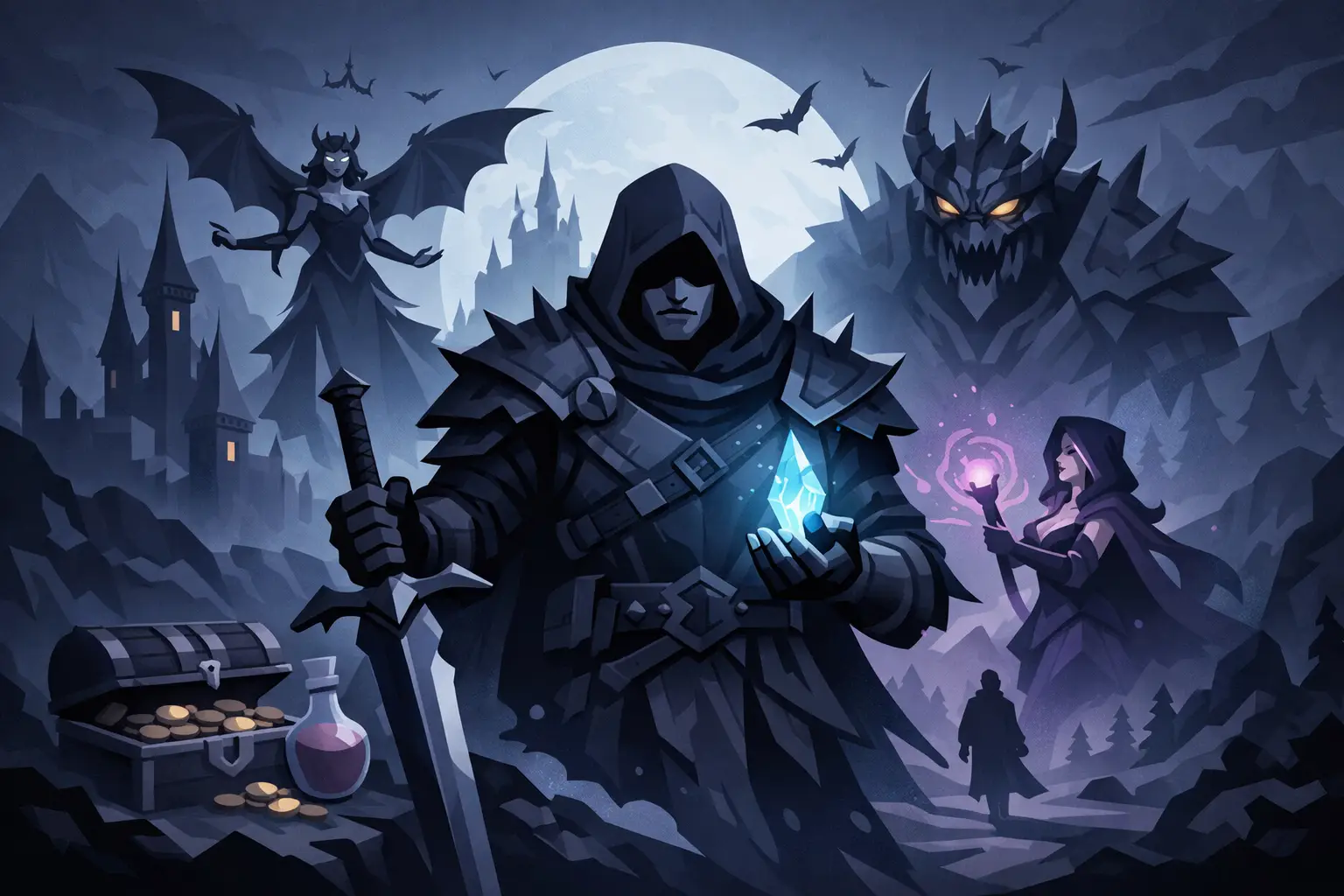
A cathedral skyline, a pale Familiar, and a screen filled with black armor are not enough to make the best gothic fantasy mobile rpg. Atmosphere may draw you into the ruins, but the games worth keeping on your phone give that darkness a purpose. Every battle should deepen your command. Every character should carry more weight than a rarity color. Every victory should feel like one more fragile stand against a world coming apart.
For players who want more than a quick visual thrill, the question is not which game is darkest. It is which one makes its world, collection, and progression systems work together over months of play.
The Best Gothic Fantasy Mobile RPG Needs a World With Consequences
Gothic fantasy is built on pressure. Kingdoms weaken, ancient powers wake, faith becomes dangerous, and survival often demands a cost. A strong mobile RPG does not need to explain every secret at once, but it should make you feel that something old and hostile is moving beneath the surface.
Look for stories that reveal themselves through locations, characters, battles, and shifting alliances rather than long walls of lore. A ruined district should suggest why it fell. A commander should have motives beyond being another opponent in a stage. When corruption spreads through enemies and environments, it should alter the feeling of the journey, not sit in the background as decoration.
This matters because mobile play happens in fragments. You may only have ten minutes between obligations, so each chapter, cinematic, or character encounter needs to leave a mark. The strongest worlds give you a reason to return beyond daily rewards. You want to know what waits beyond the next Gate, who benefits from the chaos, and whether your growing force can withstand what follows.
Collection Should Create Command, Not Clutter
Hero collectors live or die by their rosters. Getting a new character should feel like gaining a possible answer to a problem, not adding another portrait to an inventory that will never matter.
The best systems give each recruit a role in a larger warband. A durable front-line protector, a curse-focused caster, a healer with conditional recovery, and a relentless finisher can create very different results even when their overall power appears similar. That variation turns collection into strategy.
Depth also needs room to breathe. Leveling, evolution, equipment, skill growth, and faction or bond systems can make a Familiar feel truly yours. Yet there is a trade-off. Too many upgrade paths, introduced too early, can bury the excitement of a new summon beneath menus and materials. A good gothic fantasy RPG reveals its systems in layers. Early decisions should be clear, while late-game players still find difficult choices in builds, synergies, and resource investment.
Collection becomes more compelling when older characters retain some value. Not every Familiar must remain top-tier in every mode, but niche utility, specific counters, and team bonuses can prevent a large roster from becoming a graveyard of abandoned recruits. The point is not to own everything. It is to understand what each soul can do under your command.
Automated Combat Still Needs Real Strategy
Automated battle is often misunderstood. Watching characters fight does not mean the player has nothing to decide. In a well-made mobile RPG, the battle is the test of choices made before the first strike lands.
Formation is where that test begins. Positioning fragile damage dealers behind defenders, protecting support units from early pressure, or placing an aggressive attacker where they can reach a priority target can change the outcome of a fight. Buffs, debuffs, control effects, skill timing, equipment, and elemental or faction relationships add further layers.
The important question is whether defeat teaches you something. If a failed stage only means your combat power is too low, progress becomes a wall. If it reveals that your formation collapses against area damage, that your healing arrives too late, or that an enemy must be controlled before it casts, you have a tactical puzzle worth solving.
That balance is especially valuable on mobile. You can set a formation during a short session, let battles resolve efficiently, then return later to refine your team. It respects the platform without reducing the experience to idle numbers. Blood Legends RPG is built around this tension: Warlords shape formations and Contracts with Familiars, while automated combat exposes the strength or weakness of every decision.
Progression Must Reward Patience Without Demanding Surrender
Long-term progression is part of the appeal. Building a force from vulnerable recruits into a formation capable of surviving raids and competitive battles should take time. The danger is confusing time with meaning.
A healthy progression loop gives players several paths forward. You might improve a core Familiar through evolution, strengthen equipment, adjust a formation, pursue a different team composition, or take on events for focused rewards. When one route slows down, another should remain possible. That does not mean every reward arrives instantly. It means effort should produce visible movement.
Pay attention to how a game handles duplicates and rare pulls. In collector RPGs, chance is unavoidable, but a system feels more respectful when duplicates contribute to a character's growth or feed a useful exchange path. Likewise, players should be able to build capable teams without requiring every newly released character. The rarest units can be exciting without making the rest of the roster irrelevant.
Live events are another measure of quality. The best events do more than repeat the standard campaign with a new reward banner. They introduce unusual enemy rules, raid mechanics, limited story pressure, or team-building restrictions that make experienced players reconsider their usual formation. A temporary threat should feel like it belongs to the same dark world, not like an unrelated distraction.
Competition Is Better When the Community Can Learn From It
Real-time multiplayer can give a hero collector its sharpest edge. Facing another player's formation exposes whether your strategy works outside predictable campaign encounters. It also creates the satisfying tension of preparing a defense that can survive when you are away.
But competitive modes need restraint. If the gap between new and established players is absolute, the arena becomes a warning rather than an aspiration. Good matchmaking, worthwhile participation rewards, seasonal goals, and clear battle information make competition more inviting. Losing can still sting, but it should reveal an adjustment to consider rather than prove that you do not belong.
Community matters here as much as systems. Players trade theories about counters, share formation ideas, compare raid results, and warn each other about threats hidden in an event. A developing live-service RPG earns loyalty when it listens to that knowledge without pretending every request can be granted immediately. Transparent updates and visible refinement create trust, especially in a world designed to expand over time.
How to Choose the Right Gothic RPG for Your Playstyle
There is no single answer for every player. If you mainly want a story to follow in short sessions, choose a game with memorable locations, readable objectives, and steady campaign pacing. If building the perfect team is the real attraction, prioritize roster depth, formation options, and upgrade systems that reward experimentation.
Players drawn to competition should examine the arena, raid structure, and event cadence before committing heavily. Those who collect for character art and lore may care more about distinct designs, obtainable favorites, and whether each new recruit feels connected to the setting. A game can be excellent at one of these things and weaker at another.
Before investing too much time, play beyond the opening hour. Early stages are meant to be welcoming. The better test comes when formations begin to matter, resources become limited, and the world asks you to make a choice rather than follow an arrow. That is where gothic fantasy either becomes a living campaign or fades into another dark-colored menu.
Choose the game whose darkness gives you something to fight for. When a new Familiar changes your plans, a lost battle teaches you how to adapt, and the next ruined horizon still feels dangerous, you have found a world worth returning to.