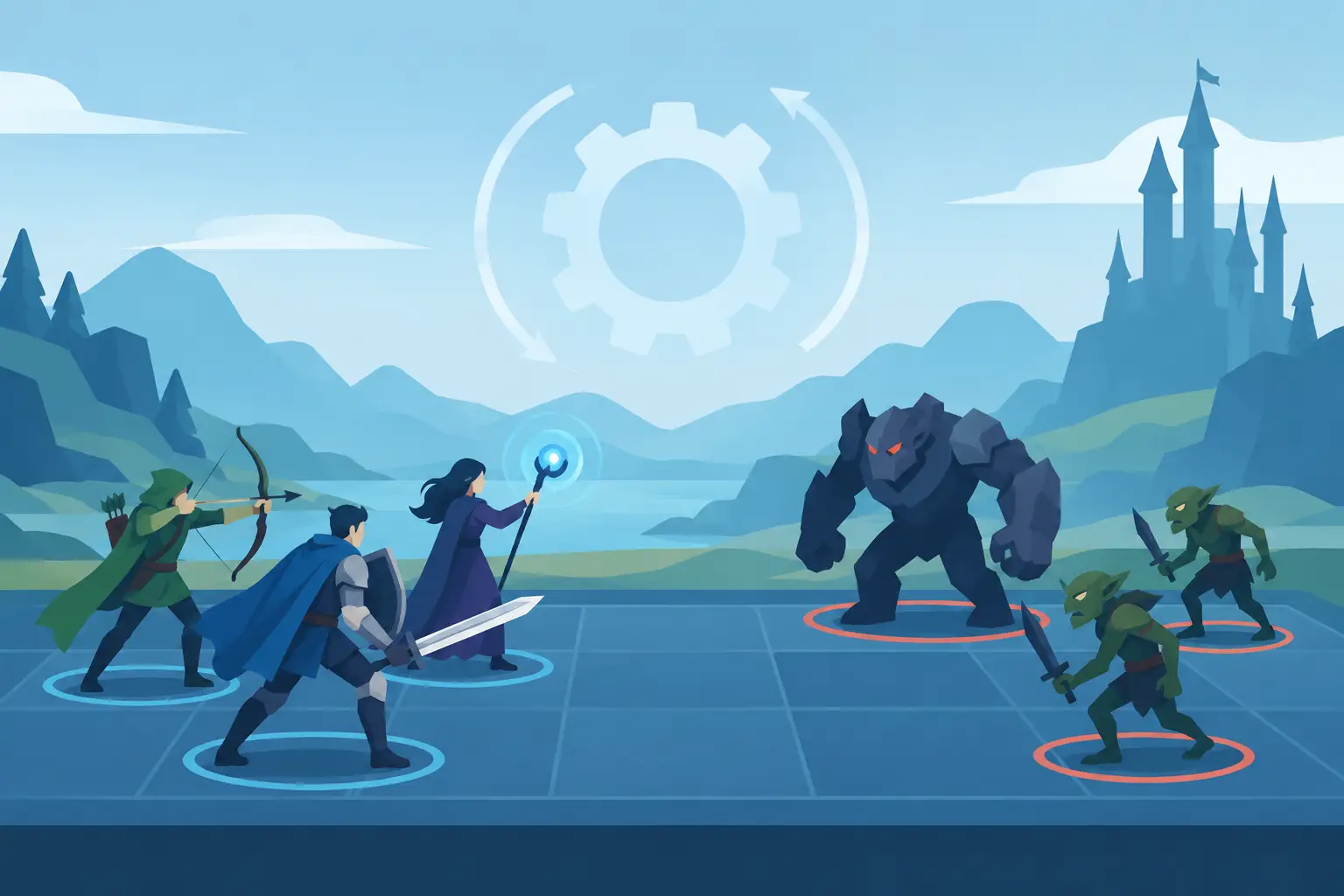
A battle can be decided before the first blade moves. In an automated turn-based RPG, that is not a weakness of the combat system. It is the point. Your Warlord, your Familiars, their placement, their growth, and the Contracts binding them together carry the weight of every encounter.
For players who enjoy dark fantasy, collecting powerful characters, and building teams that survive impossible odds, automation changes where strategy lives. It moves the decision from a button press in the moment to the preparation that comes before the fight. When corruption spreads beyond the Gates and another hostile force stands in your path, a stronger formation matters more than faster fingers.
What Automated Combat Really Changes
Traditional turn-based RPGs ask players to select every attack, spell, and target during battle. Automated combat follows a different covenant. Characters act according to their stats, skills, speed, position, active effects, and the rules of their abilities. The player sets the conditions. The team carries them into battle.
That makes each result easier to read. If a frontline Familiar collapses too quickly, the problem may be its defenses, its equipment, or the support standing behind it. If an enemy healer keeps extending the fight, your formation may lack enough focused damage, control effects, or timing to break through. Defeat becomes information, not just a missed input.
This design also respects mobile play. You can make meaningful progression during a short break, run encounters while managing your roster, and return to the deeper decisions when you have time. Automation should never mean absence. It should mean the battle reveals the quality of the plan you built.
Strategy Begins Before the First Turn
The strongest automated turn-based RPG systems give players many ways to shape an outcome. Team-building is not simply a matter of placing the highest-power units together. A character with impressive individual damage can still fail if its skills need protection, buffs, a particular position, or allies that exploit the debuffs it creates.
Formation Is a Weapon
Positioning establishes the first law of battle. Durable Familiars belong where they can absorb pressure. Fragile damage dealers need cover. Support units may need to survive long enough to cleanse harmful effects, strengthen allies, or turn a losing exchange into a recovery.
Formation decisions become especially valuable when enemies have recognizable patterns. A hostile line that punishes the front row calls for different defenses than one that hunts the backline. A raid boss that deals crushing area damage asks whether your team can endure a long fight, not merely win a quick one.
There is no permanent perfect formation. Story encounters, events, raids, and multiplayer opponents create different demands. The team that clears a campaign stage efficiently may be too vulnerable for a drawn-out boss battle. That tension gives roster depth a purpose.
Skills Create Combinations, Not Decorations
Automated skills are most satisfying when they interact. One Familiar may weaken an enemy's defenses, while another follows with high damage. A protector may gain value from being attacked. A support character may become essential because its buffs allow a slower ally to act before being destroyed.
Buffs, debuffs, control effects, healing, shields, and damage types all create room for planning. The goal is not to memorize a hundred exceptions. It is to understand what your current team is trying to do. Is it built to outlast enemies? Erase a priority target? Wear down the opposition with harmful effects? Prevent the enemy from establishing momentum?
Once that identity is clear, upgrades become more deliberate. You stop investing only in visible power and start investing in the pieces that make the formation function.
Collection Has Meaning When Growth Has Trade-Offs
A hero collector needs more than striking character art and a larger roster. Every new Familiar should present a possibility: a missing role, a new synergy, a counter to a difficult enemy, or a path to a different style of team.
Long-term progression gives those possibilities weight. Leveling, evolution, equipment, stat empowerment, and Blood Bond skill development can transform a newly acquired Familiar into a central part of a formation. Yet resources are rarely limitless. Committing too heavily to a unit that does not fit your direction can delay another team that would better answer the threats ahead.
That does not mean every decision must be punishing. A good mobile RPG lets players experiment, learn, and recover from early choices. But some restraint keeps collection meaningful. If every Familiar becomes identical after enough upgrades, the roster loses its mystery.
In Blood Legends RPG, the Warlord is not a temporary avatar to discard when a new banner arrives. Choosing one of eight permanent Warlords establishes a lasting presence in a world fractured by war, exile, and the corruption surrounding ancient Gates. Familiars expand that power, but the Warlord remains at the center of the formation and its future.
Why Losses Matter More in Automated Battles
Manual combat can sometimes hide a weak team behind perfect timing or repeated retries. An automated system is less forgiving, but it can be more honest. It asks whether the team itself can withstand the encounter.
When a stage goes wrong, resist the urge to improve everything at once. Watch for the moment the formation breaks. Did the frontline fall before support skills mattered? Did the enemy's dangerous unit remain untouched? Did your team lack healing, control, or enough damage to finish the fight before pressure became overwhelming?
Small adjustments can produce dramatic changes. Moving a defender, replacing one damage dealer with a support Familiar, improving equipment on a key survivor, or shifting toward a different skill interaction may matter more than raising the entire roster by a few levels. This is where automated combat earns its depth: the player is solving a tactical problem rather than reacting to an animation.
The Best Teams Are Built for More Than One Battle
Campaign progression is only one road through a living dark-fantasy world. Events can introduce unusual enemy rules. Raid battles can reward sustained damage and survival. Real-time multiplayer can expose formations that work against predictable enemies but fail against another Warlord's carefully assembled roster.
A wide collection helps, but a thoughtful one helps more. Build a reliable core first, then develop alternatives for the challenges that punish your usual approach. Keep an eye on units that seem situational. The Familiar that sits unused in story battles may become vital when a new raid mechanic or competitive formation appears.
This is also where community knowledge has real value. Players who compare formations, discuss enemy behavior, and share hard-won discoveries help reveal options that raw power ratings cannot show. In a world moving toward catastrophe, no Warlord survives by assuming the first answer is the only one.
Automation Leaves Room for the World
There is another reason automated combat belongs in a story-driven mobile RPG: it gives the world room to breathe. You can focus on the ruins beyond a Gate, the consequences of a failed Contract, the factions struggling over a dying territory, and the Familiars caught in conflicts older than any current war.
The battle remains important, but it does not demand that you spend every second issuing the same command. Instead, combat becomes part of the larger rhythm: explore, recruit, strengthen, test a formation, and press farther into places where the corruption has already taken hold.
An automated turn-based RPG is at its best when it trusts players with the decisions that matter. Build with intent, study each defeat, and let every Familiar earn a place in the formation before the next Gate opens.