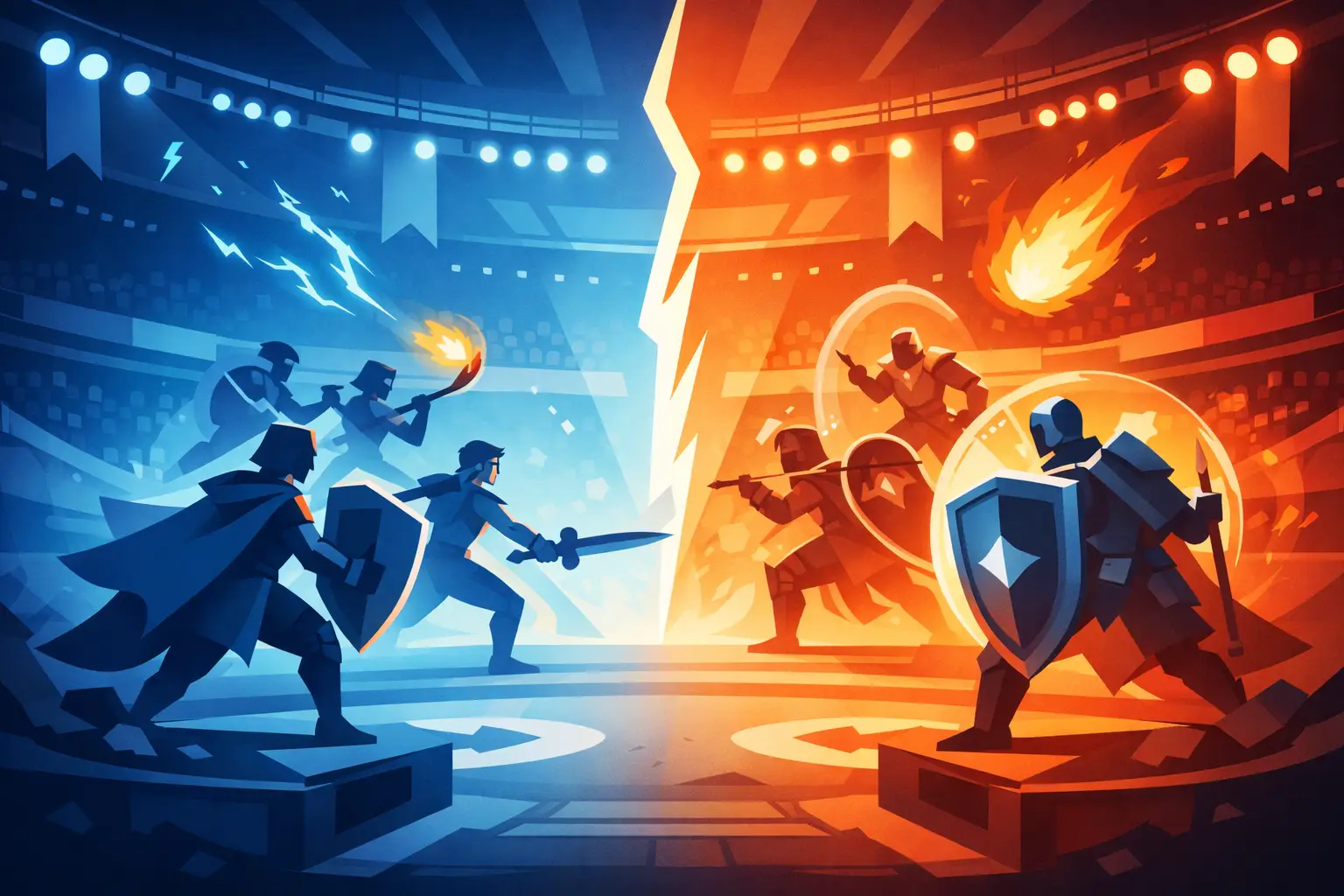
The arena does not reward the Warlord with the largest collection. It rewards the one whose formation survives the first collapse, identifies the enemy’s weak point, and turns a few brutal seconds of automated combat into a decisive kill. Arena offense versus defense is not a choice between two separate modes of power. It is the discipline of building a roster that can hunt, endure, and force opponents to make bad assumptions.
In Blood Legends, every Familiar enters battle with more than raw stats. Positioning, skills, Blood Bond progress, equipment, buffs, debuffs, and the Warlord leading the formation all shape the result. Since combat resolves automatically, preparation carries the weight that manual reactions carry in other RPGs. The arena is won before the first skill is cast.
Arena Offense Versus Defense Starts With Purpose
An offensive formation has one clear job: create a favorable battle state quickly enough that the opponent cannot recover. That may mean erasing a fragile damage dealer, locking down a healer, or piling debuffs onto a front line before its protection can matter. Offense values timing, target access, and concentrated pressure.
Defense has a harsher task. It must perform without you present to adjust it. A defensive formation needs to absorb unfamiliar threats, prevent an early execution, and punish predictable attackers for committing too deeply. It is not simply offense with more health. A slow team that cannot threaten anyone gives the attacker time to set up the perfect answer.
The distinction matters because the same Familiar can be exceptional on attack and unreliable on defense. A high-damage specialist that destroys one common formation may be your best weapon when you choose the target. On defense, however, opponents can see the threat coming and bring control, protection, or a counter element designed to remove it. Your arena roster should be judged by the conditions it creates, not by a single power number.
Build Offense to Break the Enemy’s Plan
Before challenging an opponent, inspect what their formation is trying to accomplish. Look beyond overall power. Which Familiar is carrying the damage? Who provides healing, shielding, control, cleansing, or defensive buffs? Is their back line exposed, or is the front line built to stall until a devastating skill cycle begins?
Your offensive team should answer that question with a focused win condition. If the enemy relies on a vulnerable support Familiar, use positioning and target pressure to reach it early. If their formation is packed with durable protectors, bring sustained damage, armor-breaking effects, healing reduction, or debuffs that grow more dangerous over time. When their threat is burst damage, survivability and control may matter more than adding another attacker.
Avoid changing the whole formation after every loss. A defeat is information, not a command to scatter resources across your roster. Ask where the battle broke: Did your front line vanish before your damage could act? Did an enemy healer undo your pressure? Did your own skills land too late? One targeted adjustment is often stronger than replacing every Familiar.
Choose a primary target
Offense becomes cleaner when you decide who must fall first. In many arena fights, the apparent tank is not the true target. A protected support may be the structure holding the entire enemy formation together. Remove that Familiar, and the rest of the team loses healing, buffs, cleansing, or control protection.
That said, target priority depends on your tools. A team with strong front-line pressure may need to break the defender where it stands rather than force a path into the back. Do not chase an ideal target if your formation has no reliable way to reach it. Build around what your Familiars actually do.
Spend resources where they change the matchup
Evolution, leveling, equipment, empowerment, and Blood Bond skills all increase strength, but the arena rewards efficient investment. A key defensive Familiar surviving one more enemy skill can transform your offense. A support gaining enough durability to deliver its first crucial effect can be worth more than a small damage increase on an attacker who already dies too soon.
Build a core of battle-ready Familiars before spreading upgrades across every new capture or summon. A wide collection gives you answers. A properly developed core lets those answers survive long enough to matter.
Build Defense to Deny Easy Answers
A defense formation should make scouting uncomfortable. If an opponent can glance at your team and immediately know which Familiar to eliminate, your defense has already given away too much. The strongest defenses layer threats: durability in front, disruption through the middle, and enough damage behind them to punish any attacker who arrives unprepared.
This does not require five identical walls. A pure stall formation can survive for a while, but if it lacks pressure, attackers can tailor a safe counter and wait for their own effects to take control. Defense needs teeth. A counterattacking bruiser, a dangerous debuffer, or a protected damage dealer forces attackers to respect more than your health bars.
Positioning is where this becomes real. Place the Familiars most likely to be targeted where they can receive protection, and avoid leaving your entire strategy dependent on one exposed unit. If a support is essential, pair it with defenses that interrupt the enemy’s access. If your formation relies on a durable front line, make sure the back line offers enough pressure that the enemy cannot simply grind it down at leisure.
Create redundancy, not confusion
Redundancy means your formation can still function after one part is lost. Two Familiars may contribute control in different ways. More than one unit may apply pressure. A backup source of support can keep the team alive if the first is suppressed.
Confusion is different. Filling a team with unrelated effects may look versatile, yet it often produces no meaningful sequence in battle. Every Familiar should contribute to the same defensive question: what happens to the attacker if their opening plan fails?
Respect the attacker’s advantage
The attacker chooses when to engage and can adjust after seeing your defense. That advantage is real. Your goal is not to build an invincible wall, because no formation remains invincible as rosters evolve and players learn the matchup. Your goal is to demand a specific answer, then ensure that answer carries risk.
A defensive team that beats casual challenges, exposes weak preparation, and occasionally catches a stronger opponent with the wrong counter is doing its work. Do not judge it only by whether it defeats every possible attacker.
The Formation Is the Battlefield
In automated arena combat, formation slots are decisions about who receives the opening violence. Front positions generally need durability, mitigation, or the ability to profit from being targeted. Back positions suit Familiars whose value lies in damage, control, or support, but a fragile back line can still be vulnerable if the enemy is built to reach it.
Test positions with intent. Moving a single Familiar can alter target patterns, skill timing, and which ally benefits from protection. If a damage dealer keeps dying, the answer may be equipment or evolution, but it may also be a formation slot that invites the wrong enemy pressure. If your tank survives yet the team still collapses, the issue may be that it is protecting the wrong ally.
Warlord choice belongs in the same conversation. Your permanent Warlord is not a decorative banner above the team. Its strengths should reinforce the formation’s plan. An aggressive lineup wants a Warlord that helps establish pressure; a resilient formation benefits from tools that prolong its crucial skill cycle. The best choice depends on the Familiars you have developed, not on a universal ranking.
Read Results Like a Warlord
Arena improvement comes from short, deliberate tests. Challenge comparable formations, watch for repeated failure points, and change one variable at a time when possible. A few losses against the same kind of enemy can reveal more than a lucky win against a weaker team.
Keep an eye on patterns across the wider arena. If many defenders rely on one style of protection, prepare a counter package rather than rebuilding your whole roster for each match. If burst teams dominate, strengthen your opening survival. If slow attrition teams rise, find ways to disrupt healing and deny their long game. The arena shifts as Warlords summon, evolve, and uncover new combinations.
The most feared defense is not the team with the loudest power rating. It is the formation that makes another Warlord pause before pressing battle. Build toward that pause, then carry the same discipline into every attack.